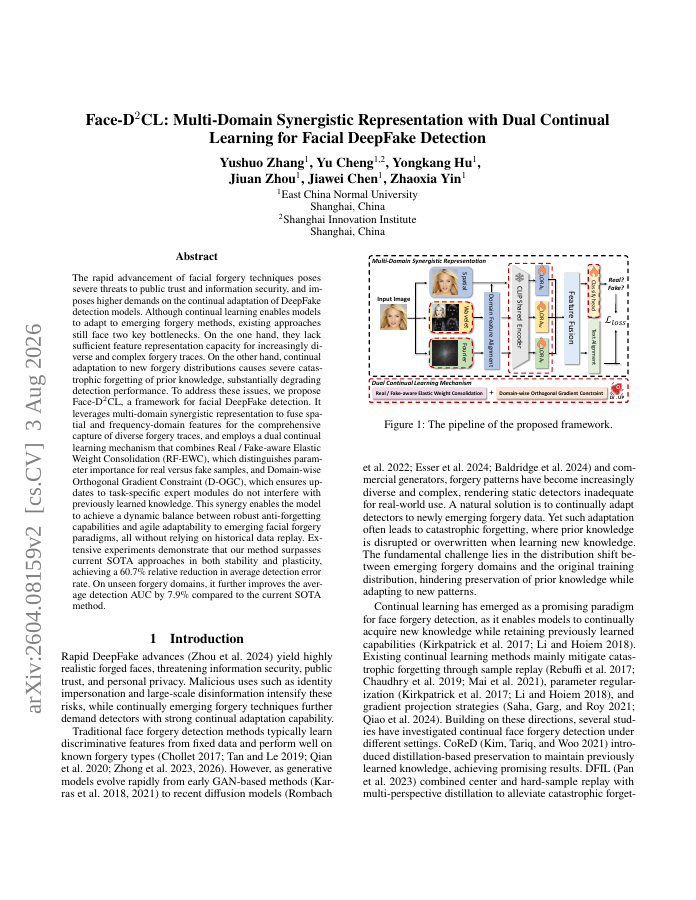
Facial forgery techniques are advancing rapidly, posing severe threats to public trust and information security while imposing higher demands on the continual adaptation of DeepFake detection models. Although continual learning enables models to adapt to emerging forgery methods, existing approaches still face two key bottlenecks. On the one hand, they lack sufficient feature representation capacity to handle increasingly diverse and complex forgery traces. On the other hand, continual adaptation to new forgery distributions leads to severe catastrophic forgetting of prior knowledge, which substantially degrades detection performance. To address these issues, we propose Face-D(^2)CL, a framework for facial DeepFake detection. It leverages multi-domain synergistic representation to fuse spatial and frequency-domain features, enabling comprehensive capture of diverse forgery traces. Additionally, it employs a dual continual learning mechanism that combines Real/Fake-aware Elastic Weight Consolidation (RF-EWC) and Domain-wise Orthogonal Gradient Constraint (D-OGC). RF-EWC distinguishes the parameter importance for real versus fake samples, while D-OGC ensures that updates to task-specific expert modules do not interfere with previously learned knowledge. This synergy allows the model to achieve a dynamic balance between robust anti-forgetting capabilities and agile adaptability to emerging facial forgery paradigms, all without relying on historical data replay. Extensive experiments demonstrate that our method surpasses current state-of-the-art (SOTA) approaches in both stability and plasticity, achieving a 60.7% relative reduction in the average detection error rate. On unseen forgery domains, it further improves the average detection AUC by 7.9% compared to the current SOTA method.
Face-D(^2)CL: Multi-Domain Synergistic Representation with Dual Continual Learning for Facial DeepFake Detection
Facial forgery techniques are advancing rapidly, posing severe threats to public trust and information security while imposing higher demands on the continual adaptation of DeepFake detection models.
- Preview
- Year
- 2026
- Hosting
- Abstract onlyARXIV-DEFAULT
Cite
Notes
Only stored in your browser.
Attribution
- Abstract & full text
- arxiv.org/abs/2604.08159ARXIV-DEFAULT
- TL;DR
- Semantic Scholar