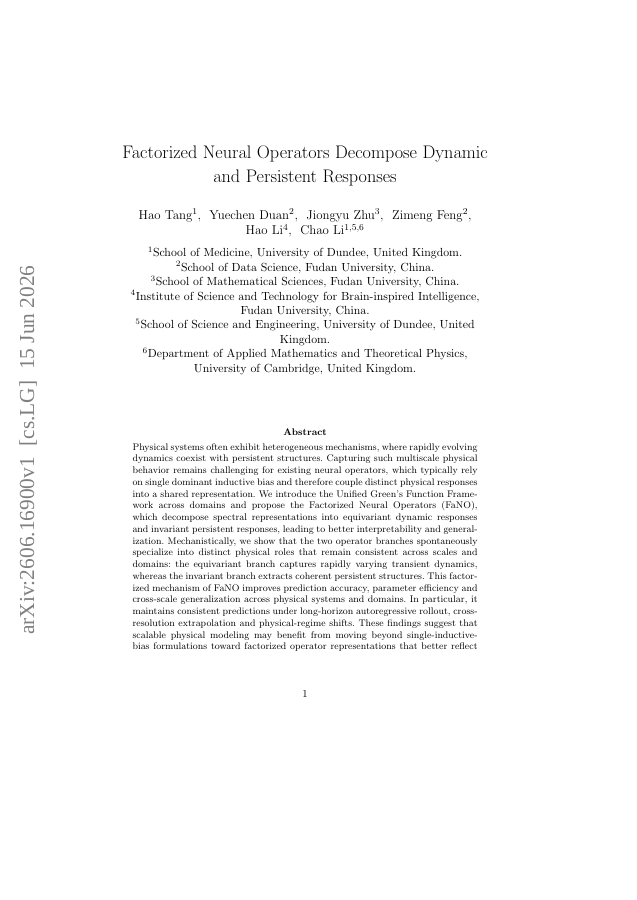
Physical systems often exhibit heterogeneous mechanisms, where rapidly evolving dynamics coexist with persistent structures. Capturing such multiscale physical behavior remains challenging for existing neural operators, which typically rely on single dominant inductive bias and therefore couple distinct physical responses into a shared representation. We introduce the Unified Green's Function Framework across domains and propose the Factorized Neural Operators (FaNO), which decompose spectral representations into equivariant-inspired dynamic responses and invariant-inspired persistent responses, leading to better interpretability and generalization. Mechanistically, we show that the two operator branches spontaneously specialize into distinct physical roles that remain consistent across scales and domains: the equivariant-inspired branch captures rapidly varying transient dynamics, whereas the invariant-inspired branch extracts coherent persistent structures. This factorized mechanism of FaNO consistently improves prediction accuracy, parameter efficiency and cross-scale generalization across physical systems and domains. In particular, it maintains consistent predictions under long-horizon autoregressive rollout, cross-resolution extrapolation and physical-regime shifts. These findings suggest that scalable physical modeling may benefit from moving beyond single-inductive-bias formulations toward factorized operator representations that better reflect the heterogeneous organization of physical systems, accelerating the reliable deployment of machine learning for scientific computing and discovery.
Factorized Neural Operators Decompose Dynamic and Persistent Responses
Physical systems often exhibit heterogeneous mechanisms, where rapidly evolving dynamics coexist with persistent structures. Capturing such multiscale physical behavior remains challenging for existing neural operators, which typically rely on single dominant inductive bias and…
- Preview
- Year
- 2026
- Hosting
- Full text hostedCC-BY-4.0
Cite
Notes
Only stored in your browser.
Attribution
- Abstract & full text
- arxiv.org/abs/2606.16900CC-BY-4.0
- TL;DR
- Semantic Scholar