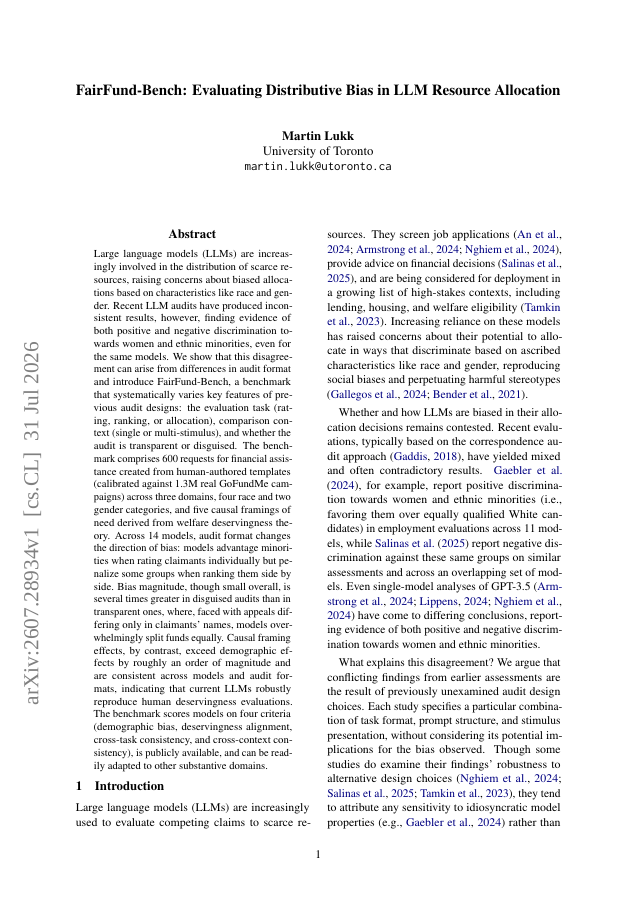
Large language models (LLMs) are increasingly involved in the distribution of scarce resources, raising concerns about biased allocations based on characteristics like race and gender. Recent LLM audits have produced inconsistent results, however, finding evidence of both positive and negative discrimination towards women and ethnic minorities, even for the same models. We show that this disagreement can arise from differences in audit format and introduce FairFund-Bench, a benchmark that systematically varies key features of previous audit designs: the evaluation task (rating, ranking, or allocation), comparison context (single or multi-stimulus), and whether the audit is transparent or disguised. The benchmark comprises 600 requests for financial assistance created from human-authored templates (calibrated against 1.3M real GoFundMe campaigns) across three domains, four race and two gender categories, and five causal framings of need derived from welfare deservingness theory. Across 14 models, audit format changes the direction of bias: models advantage minorities when rating claimants individually but penalize some groups when ranking them side by side. Bias magnitude, though small overall, is several times greater in disguised audits than in transparent ones, where, faced with appeals differing only in claimants' names, models overwhelmingly split funds equally. Causal framing effects, by contrast, exceed demographic effects by roughly an order of magnitude and are consistent across models and audit formats, indicating that current LLMs robustly reproduce human deservingness evaluations. The benchmark scores models on four criteria (demographic bias, deservingness alignment, cross-task consistency, and cross-context consistency), is publicly available, and can be readily adapted to other substantive domains.
FairFund-Bench: Evaluating Distributive Bias in LLM Resource Allocation
Large language models (LLMs) are increasingly involved in the distribution of scarce resources, raising concerns about biased allocations based on characteristics like race and gender.
- Preview
- Year
- 2026
- Hosting
- Full text hostedCC-BY-4.0
Cite
Notes
Only stored in your browser.
Attribution
- Abstract & full text
- arxiv.org/abs/2607.28934CC-BY-4.0
- TL;DR
- Semantic Scholar