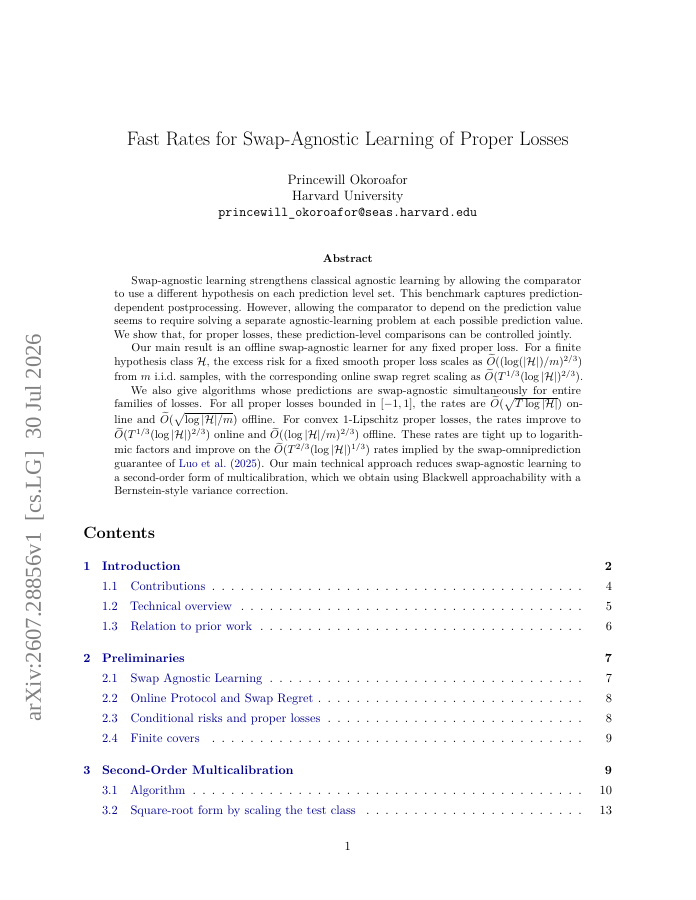
Swap-agnostic learning strengthens classical agnostic learning by allowing the comparator to select a different hypothesis on each level set of the learner's predictions. This benchmark captures prediction-dependent postprocessing, but appears to require solving a separate agnostic-learning problem for every possible prediction value. We show that, for proper losses, these prediction-level comparisons can instead be controlled jointly. Our main result is an offline swap-agnostic learner for any fixed proper loss. For a finite hypothesis class H and any fixed smooth proper loss, the excess risk from m i.i.d. samples is \widetilde{O}((\log |H|/m)^{2/3}), with a corresponding online swap-regret bound of \widetilde{O}(T^{1/3}(\log |H|)^{2/3}). We also give algorithms whose predictions are simultaneously swap-agnostic for entire families of losses. For all proper losses bounded in [-1,1], we obtain online and offline rates of \widetilde{O}(\sqrt{T\log |H|}) and \widetilde{O}(\sqrt{\log |H|/m}), respectively. For convex, 1-Lipschitz proper losses, these rates improve to \widetilde{O}(T^{1/3}(\log |H|)^{2/3}) online and \widetilde{O}((\log |H|/m)^{2/3}) offline. These bounds are tight up to logarithmic factors and improve upon the \widetilde{O}(T^{2/3}(\log |H|)^{1/3}) rate implied by the swap-omniprediction guarantee of Luo et al. (2025). Our main technical contribution is a reduction from swap-agnostic learning to a second-order form of multicalibration, obtained via Blackwell approachability with a Bernstein-style variance correction.
Fast Rates for Swap-Agnostic Learning of Proper Losses
Swap-agnostic learning strengthens classical agnostic learning by allowing the comparator to select a different hypothesis on each level set of the learner's predictions.
- Preview
- Year
- 2026
- Hosting
- Full text hostedCC-BY-SA-4.0
Cite
Notes
Only stored in your browser.
Attribution
- Abstract & full text
- arxiv.org/abs/2607.28856CC-BY-SA-4.0
- TL;DR
- Semantic Scholar