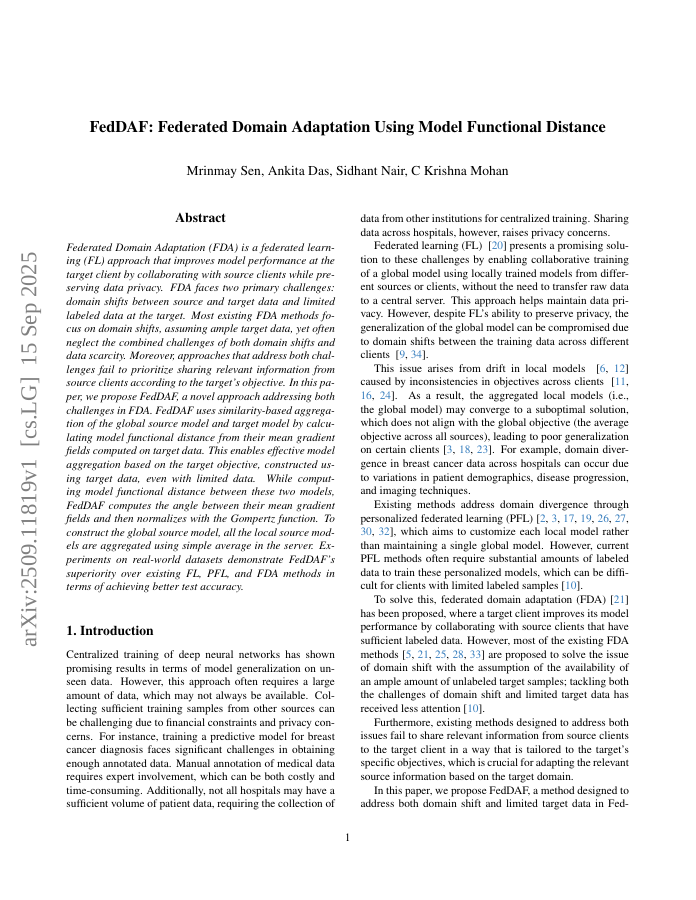
Federated Domain Adaptation (FDA) improves model performance at a target client by collaborating with source clients while preserving data privacy. FDA faces two key challenges: domain shift between source and target data, and limited labeled data at the target, a common constraint when a new site joins a federation before it has accumulated its own labeled data, as in clinical deployments. Most existing methods address domain shift alone, assuming ample target data; those that also tackle data scarcity still fail to prioritize source information according to the target's specific objective. We propose FedDAF, which addresses both challenges through similarity-based aggregation of the global source and target models, using their model functional distance, computed from the angle between their mean gradient fields on target data and normalized via a Gompertz function. The global source model itself is formed using a distance-based weighted average, giving greater weight to source models closer to the target model. Experiments on real-world datasets show FedDAF outperforms existing federated learning (FL), personalized FL, and FDA methods in test accuracy.
FedDAF: Federated Domain Adaptation Using Model Functional Distance
Federated Domain Adaptation (FDA) improves model performance at a target client by collaborating with source clients while preserving data privacy. FDA faces two key challenges: domain shift between source and target data, and limited labeled data at the target, a common…
- Preview
- Year
- 2025
- Hosting
- Full text hostedCC-BY-4.0
Cite
Notes
Only stored in your browser.
Attribution
- Abstract & full text
- arxiv.org/abs/2509.11819CC-BY-4.0
- TL;DR
- Semantic Scholar