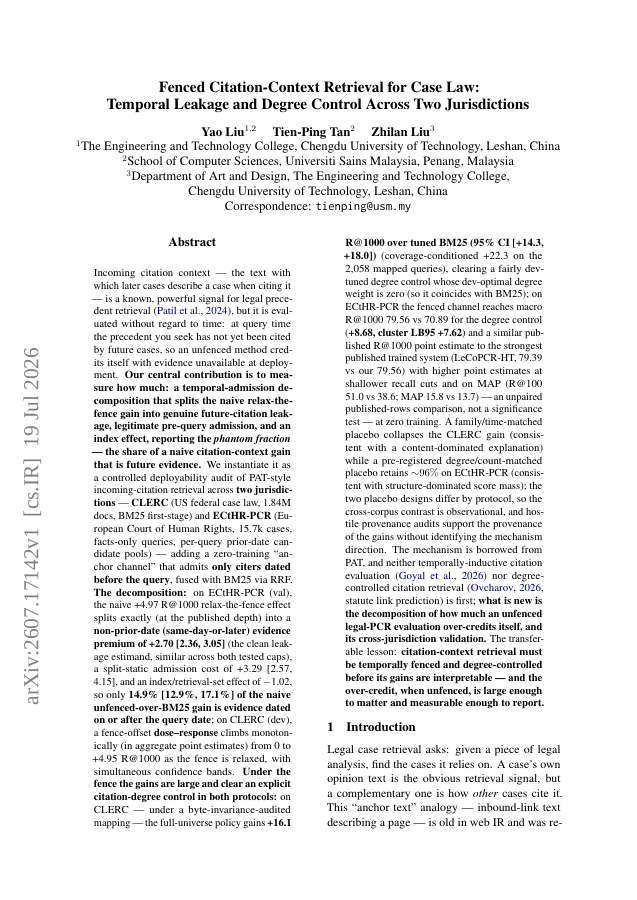
Prior case retrieval (PCR) aims to identify the precedent cases relevant to the facts of a query case. Incoming citation context, the text with which later cases characterize a case when citing it, is a powerful relevance signal, yet it is typically evaluated without a temporal constraint, so the retriever is credited with citations made after the query. We introduce a zero-training, temporally fenced retriever that augments BM25 with incoming citation context restricted to citations predating the query, together with a temporal-admission decomposition that quantifies the phantom fraction: the share of a citation-context gain attributable to citations not known to predate the query. Experiments span two jurisdictions, U.S. federal (CLERC) and European (ECtHR-PCR) case law. On ECtHR-PCR, without any training, the fenced retriever outperforms a strong degree-controlled baseline across the full recall ladder, and a temporal-admission decomposition attributes 14.9% (validation) of an unfenced citation-context gain over BM25 to citations not known to predate the query. Citation-context retrieval must therefore be temporally fenced and degree-controlled before its reported gains can be interpreted.
Fenced Citation-Context Retrieval for Case Law: Temporal Leakage and Degree Control Across Two Jurisdictions
Prior case retrieval (PCR) aims to identify the precedent cases relevant to the facts of a query case. Incoming citation context, the text with which later cases characterize a case when citing it, is a powerful relevance signal, yet it is typically evaluated without a temporal…
- Preview
- Year
- 2026
- Hosting
- Full text hostedCC-BY-4.0
Cite
Notes
Only stored in your browser.
Attribution
- Abstract & full text
- arxiv.org/abs/2607.17142CC-BY-4.0
- TL;DR
- Semantic Scholar