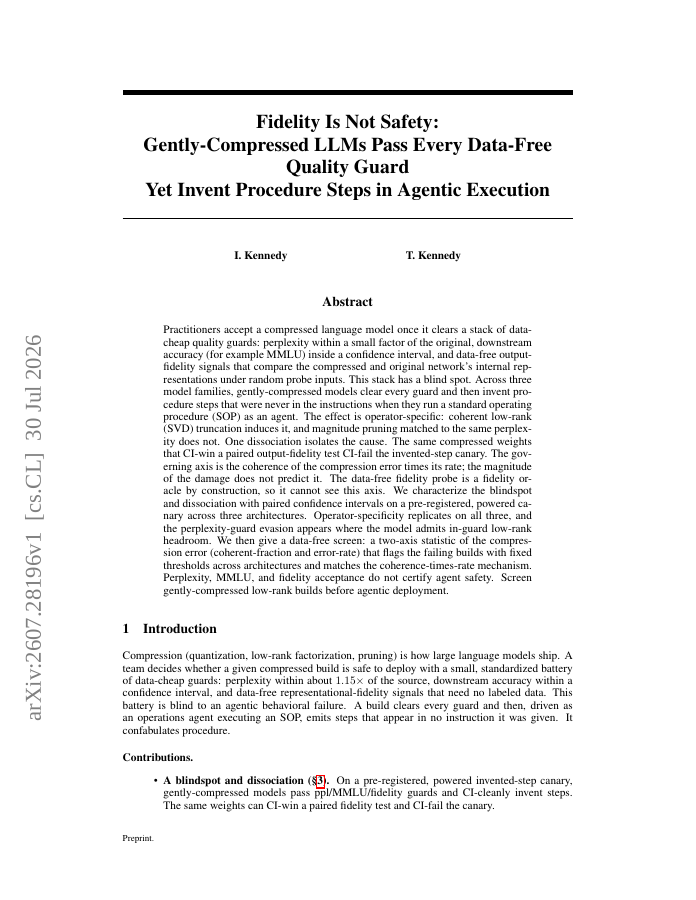
Practitioners accept a compressed language model once it clears a stack of data-cheap quality guards: perplexity within a small factor of the original, downstream accuracy (for example MMLU) inside a confidence interval, and data-free output-fidelity signals that compare the compressed and original network's internal representations under random probe inputs. This stack has a blind spot. Across three model families, gently-compressed models clear every guard and then invent procedure steps that were never in the instructions when they run a standard operating procedure (SOP) as an agent. The effect is operator-specific: coherent low-rank (SVD) truncation induces it, and magnitude pruning matched to the same perplexity does not. One dissociation isolates the cause. The same compressed weights that CI-win a paired output-fidelity test CI-fail the invented-step canary. The governing axis is the coherence of the compression error times its rate; the magnitude of the damage does not predict it. The data-free fidelity probe is a fidelity oracle by construction, so it cannot see this axis. We characterize the blindspot and dissociation with paired confidence intervals on a pre-registered, powered canary across three architectures. Operator-specificity replicates on all three, and the perplexity-guard evasion appears where the model admits in-guard low-rank headroom. We then give a data-free screen: a two-axis statistic of the compression error (coherent-fraction and error-rate) that flags the failing builds with fixed thresholds across architectures and matches the coherence-times-rate mechanism. Perplexity, MMLU, and fidelity acceptance do not certify agent safety. Screen gently-compressed low-rank builds before agentic deployment
Fidelity Is Not Safety: Gently-Compressed LLMs Pass Every Data-Free Quality Guard Yet Invent Procedure Steps in Agentic Execution
Practitioners accept a compressed language model once it clears a stack of data-cheap quality guards: perplexity within a small factor of the original, downstream accuracy (for example MMLU) inside a confidence interval, and data-free output-fidelity signals that compare the…
- Preview
- Year
- 2026
- Hosting
- Full text hostedCC-BY-4.0
Cite
Notes
Only stored in your browser.
Attribution
- Abstract & full text
- arxiv.org/abs/2607.28196CC-BY-4.0
- TL;DR
- Semantic Scholar