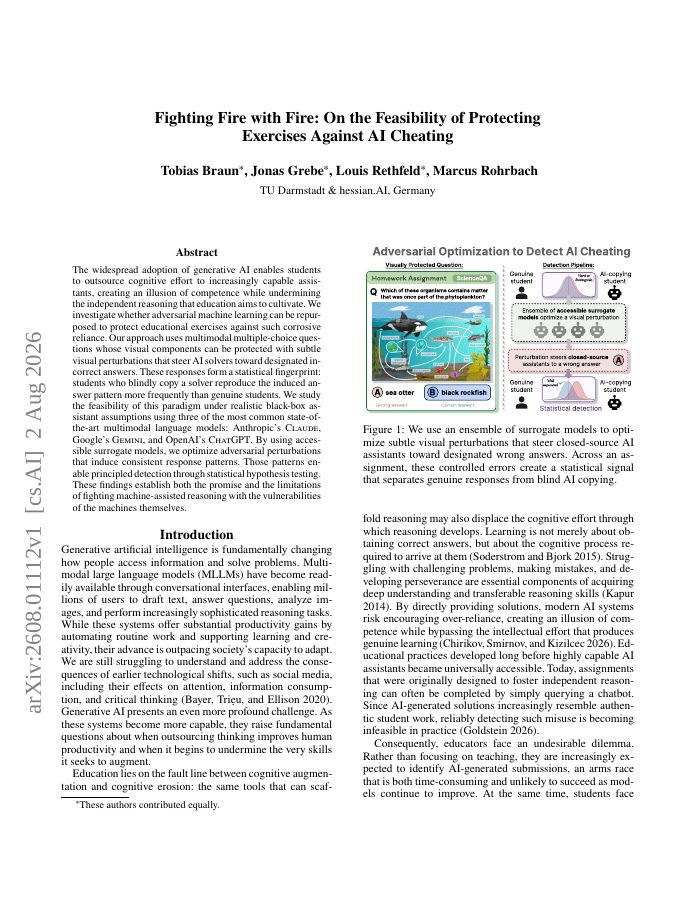
The widespread adoption of generative AI enables students to outsource cognitive effort to increasingly capable assistants, creating an illusion of competence while undermining the independent reasoning that education aims to cultivate. We investigate whether adversarial machine learning can be repurposed to protect educational exercises against such corrosive reliance. Our approach uses multimodal multiple-choice questions whose visual components can be protected with subtle visual perturbations that steer AI solvers toward designated incorrect answers. These responses form a statistical fingerprint: students who blindly copy a solver reproduce the induced answer pattern more frequently than genuine students. We study the feasibility of this paradigm under realistic black-box assistant assumptions using three of the most common state-of-the-art multimodal language models: Anthropic's Claude, Google's Gemini, and OpenAI's ChatGPT. By using accessible surrogate models, we optimize adversarial perturbations that induce consistent response patterns. Those patterns enable principled detection through statistical hypothesis testing. These findings establish both the promise and the limitations of fighting machine-assisted reasoning with the vulnerabilities of the machines themselves.
Fighting Fire with Fire: On the Feasibility of Protecting Exercises Against AI Cheating
The widespread adoption of generative AI enables students to outsource cognitive effort to increasingly capable assistants, creating an illusion of competence while undermining the independent reasoning that education aims to cultivate.
- Preview
- Year
- 2026
- Hosting
- Abstract onlyARXIV-DEFAULT
Cite
Notes
Only stored in your browser.
Attribution
- Abstract & full text
- arxiv.org/abs/2608.01112ARXIV-DEFAULT
- TL;DR
- Semantic Scholar