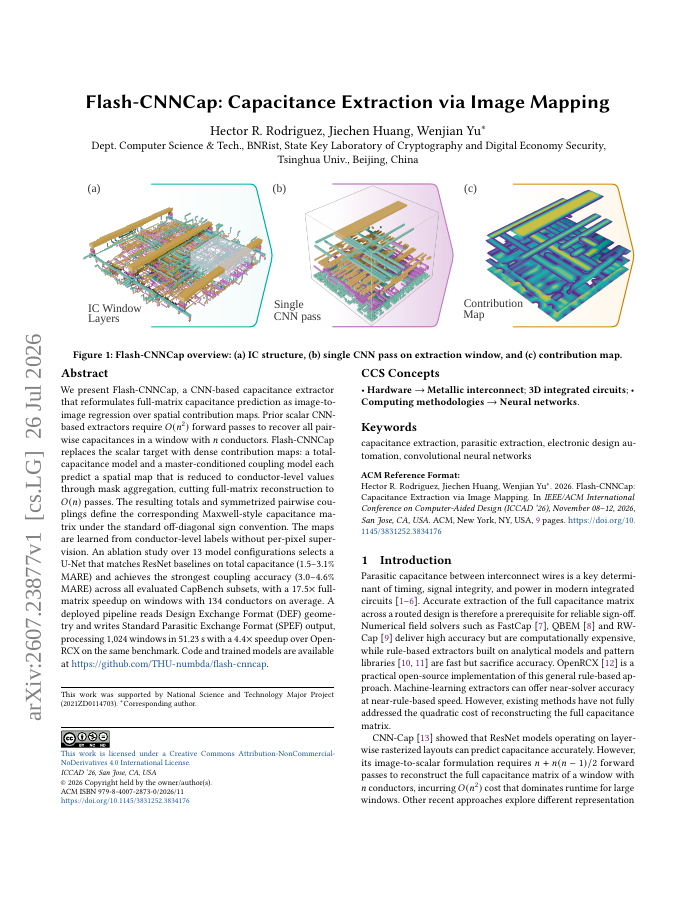
We present Flash-CNNCap, a CNN-based capacitance extractor that reformulates full-matrix capacitance prediction as image-to-image regression over spatial contribution maps. Prior scalar CNN-based extractors require O(n^2) forward passes to recover all pairwise capacitances in a window with n conductors. Flash-CNNCap replaces the scalar target with dense contribution maps: a total-capacitance model and a master-conditioned coupling model each predict a spatial map that is reduced to conductor-level values through mask aggregation, cutting full-matrix reconstruction to O(n) passes. The resulting totals and symmetrized pairwise couplings define the corresponding Maxwell-style capacitance matrix under the standard off-diagonal sign convention. The maps are learned from conductor-level labels without per-pixel supervision. An ablation study over 13 model configurations selects a U-Net that matches ResNet baselines on total capacitance (1.5-3.1% MARE) and achieves the strongest coupling accuracy (3.0-4.6% MARE) across all evaluated CapBench subsets, with a 17.5\times full-matrix speedup on windows containing 134 conductors on average. A deployed pipeline reads Design Exchange Format (DEF) geometry and writes Standard Parasitic Exchange Format (SPEF) output, processing 1,024 windows in 51.23 seconds with a 4.4\times speedup over OpenRCX on the same benchmark. Code and trained models are available at https://github.com/THU-numbda/flash-cnncap.
Flash-CNNCap: Capacitance Extraction via Image Mapping
We present Flash-CNNCap, a CNN-based capacitance extractor that reformulates full-matrix capacitance prediction as image-to-image regression over spatial contribution maps.
- Preview
- Year
- 2026
- Hosting
- Excerpt onlyCC-BY-NC-4.0
Cite
Notes
Only stored in your browser.
Attribution
- Abstract & full text
- arxiv.org/abs/2607.23877CC-BY-NC-4.0
- TL;DR
- Semantic Scholar