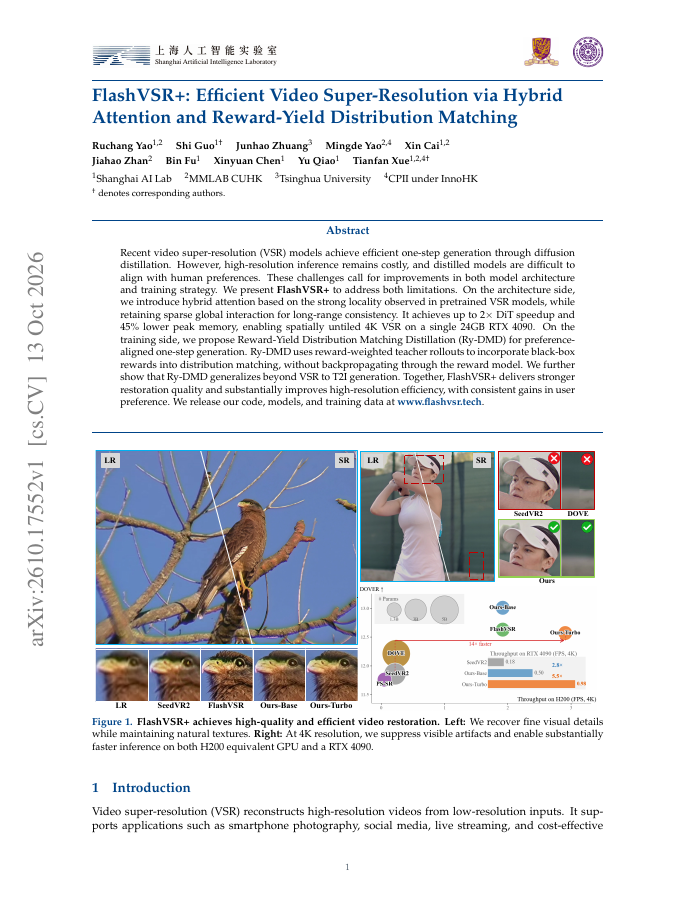
Recent video super-resolution (VSR) models achieve efficient one-step generation through diffusion distillation. However, high-resolution inference remains costly, and distilled models are difficult to align with human preferences. These challenges call for improvements in both model architecture and training strategy. We present FlashVSR+ to address both limitations. On the architecture side, we introduce hybrid attention based on the strong locality observed in pretrained VSR models, while retaining sparse global interaction for long-range consistency. It achieves up to 2\times DiT speedup and 45% lower peak memory, enabling spatially untiled 4K VSR on a single 24GB RTX 4090. On the training side, we propose Reward-Yield Distribution Matching Distillation (Ry-DMD) for preference-aligned one-step generation. Ry-DMD uses reward-weighted teacher rollouts to incorporate black-box rewards into distribution matching, without backpropagating through the reward model. We further show that Ry-DMD generalizes beyond VSR to T2I generation. Together, FlashVSR+ delivers stronger restoration quality and substantially improves high-resolution efficiency, with consistent gains in user preference. We release our code, models, and training data at \href{https://www.flashvsr.tech}{\textcolor{FlashBlue}{www.flashvsr.tech}}.
FlashVSR+: Efficient Video Super-Resolution via Hybrid Attention and Reward-Yield Distribution Matching
Recent video super-resolution (VSR) models achieve efficient one-step generation through diffusion distillation. However, high-resolution inference remains costly, and distilled models are difficult to align with human preferences.
- Preview
- Year
- 2026
- Stars
- 93
- Hosting
- Full text hostedCC-BY-4.0
Cite
Notes
Only stored in your browser.
Attribution
- Abstract & full text
- arxiv.org/abs/2610.17552CC-BY-4.0
- TL;DR
- Semantic Scholar