20 Aug 2026
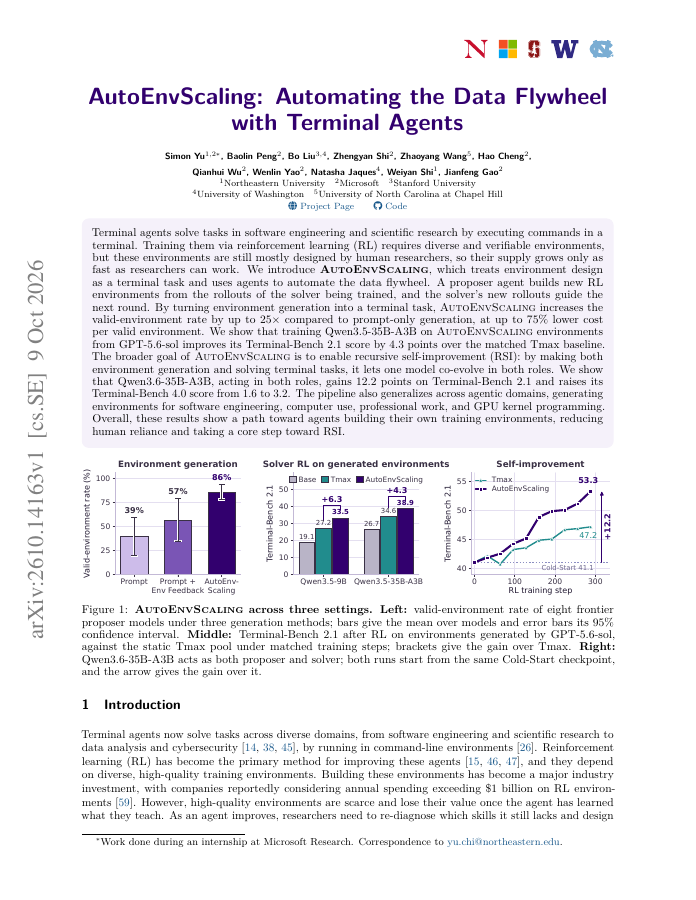
LLM agents learn by interacting with environments, yet these environments are hand-built and static: blind to an agent's weaknesses, and quickly left behind as it improves.
Trending research and the full catalog - each paper linked to the benchmarks, methods, and models it introduces.
20 Aug 2026
LLM agents learn by interacting with environments, yet these environments are hand-built and static: blind to an agent's weaknesses, and quickly left behind as it improves.
27 Aug 2026
Recent prominent post-training methods, such as Reinforcement Learning (RL) and On-Policy Self-Distillation (OPSD), have driven rapid progress in mathematical reasoning for large language models, yet their reliance on ground-truth labels precludes test-time training (TTT).
15 Aug 2026
Constructing an interactive 3D open world from a user query is important. However, existing methods are primarily evaluated on idealized, simple queries, making it difficult to systematically analyze and compare how multimodal agents understand user intent, use 3D tools, and…
26 Aug 2026
Vision-language models can produce fluent answers that are insufficiently grounded in the visual evidence: a single unsupported object, chart value, or intermediate inference can undermine an otherwise plausible response.
19 Aug 2026
Continuous self-improvement requires an ever-expanding pool of self-generated, diverse, adaptive goals. For language agents, existing training environment pools (hand-curated, statically synthesized, or frozen-verifier) keep the goal distribution fixed as the learner scales.
18 Aug 2026
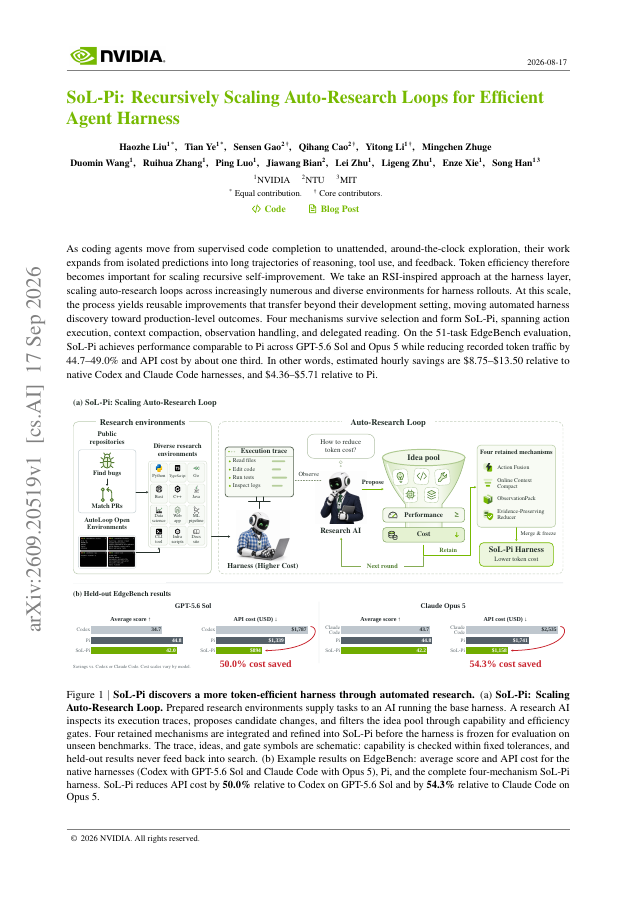
Modern agents operate inside agent harnesses that manage tools, context, and control flow, making the harness a critical part of the agent system. Our original Agent Lightning introduced a disaggregated architecture that connects arbitrary agents to RL training through an LLM…
26 Aug 2026
Test-time scaling uses extra test-time compute to improve performance, such as letting language models reason longer when solving a problem. As models keep the entire reasoning trace in memory via full attention, hard tasks that need long thinking can be prohibitively expensive.
25 Aug 2026
Reinforcement Learning with Verifiable Rewards (RLVR) and on-policy distillation (OPD) have become two widely adopted paradigms for post-training large language models. However, RLVR suffers from sparse task-level feedback, while OPD provides dense token-level guidance but…
13 Aug 2026
Transforming multimodal sources into condensed and structured media outputs can be fundamentally conceptualized as a long-horizon agentic process centered on a model-harness system.
18 Aug 2026
Artificial superintelligence (ASI) requires AI to move beyond mastering existing knowledge toward exploring the unknown, creating new knowledge, and turning new ideas into verifiable results.
26 Aug 2026
Native visual reasoning treats visual generation as the medium of reasoning itself: visual states (i.e. images and videos) are not merely inputs to be understood or outputs to be rendered, but first-class substrates for problem solving beyond language.
13 Aug 2026
Scientific discovery increasingly requires AI systems that can reason over scientific evidence of heterogeneous modalities, interact with scientific tools and environments, and sustain progress across long task horizons.
25 Aug 2026
Massively parallel simulation changes the data regime in which off-policy reinforcement learning (RL) is trained, challenging stabilizers designed for data-limited replay.
24 Aug 2026
Group-based reinforcement learning methods such as GRPO for large language models avoid training a critic by sampling multiple responses for each prompt. A reliable critic could instead estimate token-level advantages from one response, but standard critic-based training recipes…
25 Aug 2026
GUI agents often encounter dynamic anomalies when deployed on Android devices, from unexpected pop-ups to action misuse, yet existing benchmarks lack systematic evaluation of agent robustness against runtime anomalies.