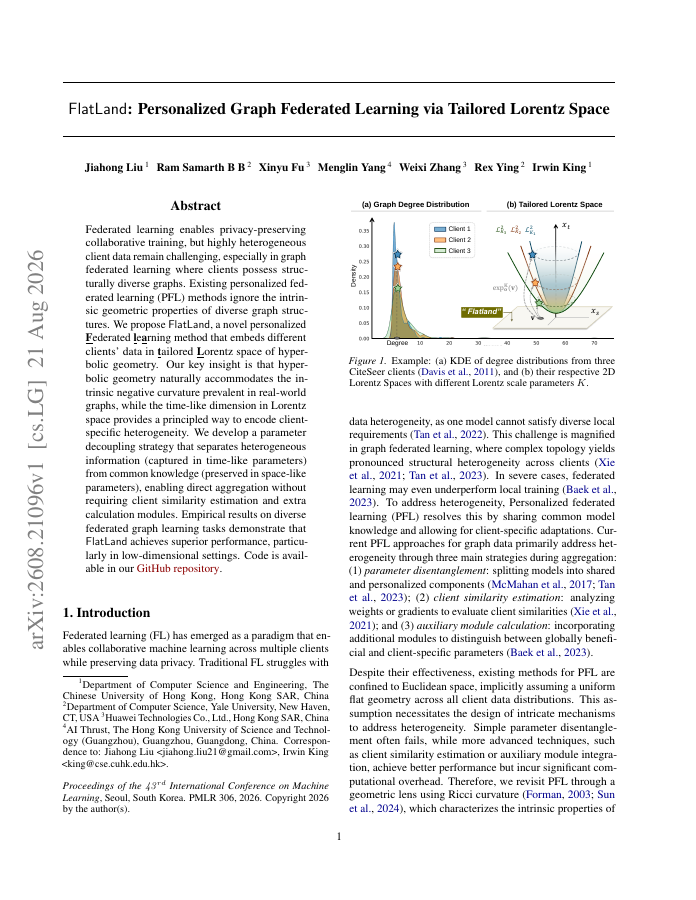
Federated learning enables privacy-preserving collaborative training, but highly heterogeneous client data remain challenging, especially in graph federated learning where clients possess structurally diverse graphs. Existing personalized federated learning (PFL) methods ignore the intrinsic geometric properties of diverse graph structures. We propose FlatLand, a novel personalized federated learning method that embeds different clients' data in tailored Lorentz space of hyperbolic geometry. Our key insight is that hyperbolic geometry naturally accommodates the intrinsic negative curvature prevalent in real-world graphs, while the time-like dimension in Lorentz space provides a principled way to encode client-specific heterogeneity. We develop a parameter decoupling strategy that separates heterogeneous information (captured in time-like parameters) from common knowledge (preserved in space-like parameters), enabling direct aggregation without requiring client similarity estimation and extra calculation modules. Empirical results on diverse federated graph learning tasks demonstrate that FlatLand achieves superior performance, particularly in low-dimensional settings.
FlatLand: Personalized Graph Federated Learning via Tailored Lorentz Space
Federated learning enables privacy-preserving collaborative training, but highly heterogeneous client data remain challenging, especially in graph federated learning where clients possess structurally diverse graphs.
- Preview
- Year
- 2026
- Hosting
- Full text hostedCC-BY-4.0
Cite
Notes
Only stored in your browser.
Attribution
- Abstract & full text
- arxiv.org/abs/2608.21096CC-BY-4.0
- TL;DR
- Semantic Scholar