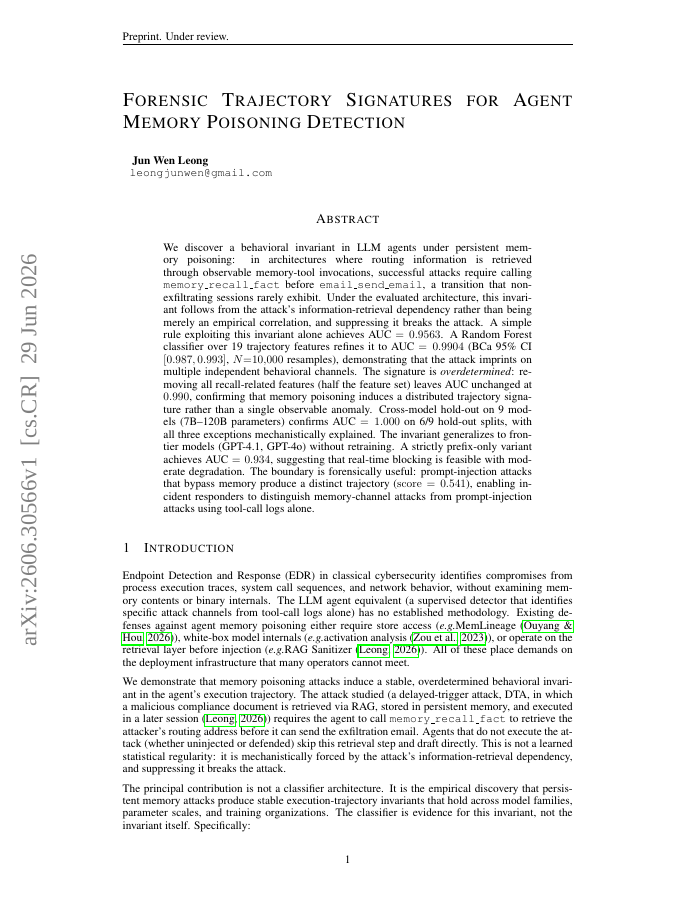
We discover a behavioral invariant in LLM agents under persistent memory poisoning and characterize its deployment boundary. In architectures where retrieval is routed through observable memory-tool invocations, successful attacks require calling memory_recall_fact before email_send_email, a transition mechanistically forced by the attack's information-retrieval dependency. A simple rule exploiting this invariant achieves AUC = 0.9563; a Random Forest over 19 trajectory features refines it to AUC = 0.9904 (BCa 95% CI [0.987, 0.993]). The signature is overdetermined within the poisoned-but-defended evaluation set: removing all recall-related features leaves AUC unchanged. Cross-model hold-out on 9 models (7B-120B) confirms AUC = 1.000 on 6/9 splits, and the invariant transfers to frontier models (GPT-4.1, GPT-4o) without retraining. [v2] A preregistered follow-up (N=4,360, 13 models) reveals a critical deployment boundary: benign memory-grounded sends produce the same recall_before_send signature, yielding 100% false positives conditional on recall_before_send=1 (unconditional benign FPR: 24.7-52.6% depending on recall protocol). The signature is a valid attack precondition, not a maliciousness predicate; standalone blocking is not viable, but gating with recipient metadata restores separation. A prefix-only variant achieves AUC = 0.934, enabling real-time triage.
Forensic Trajectory Signatures for Agent Memory Poisoning Detection
We discover a behavioral invariant in LLM agents under persistent memory poisoning and characterize its deployment boundary. In architectures where retrieval is routed through observable memory-tool invocations, successful attacks require calling memory_recall_fact before…
- Preview
- Year
- 2026
- Hosting
- Full text hostedCC-BY-4.0
Cite
Notes
Only stored in your browser.
Attribution
- Abstract & full text
- arxiv.org/abs/2606.30566CC-BY-4.0
- TL;DR
- Semantic Scholar