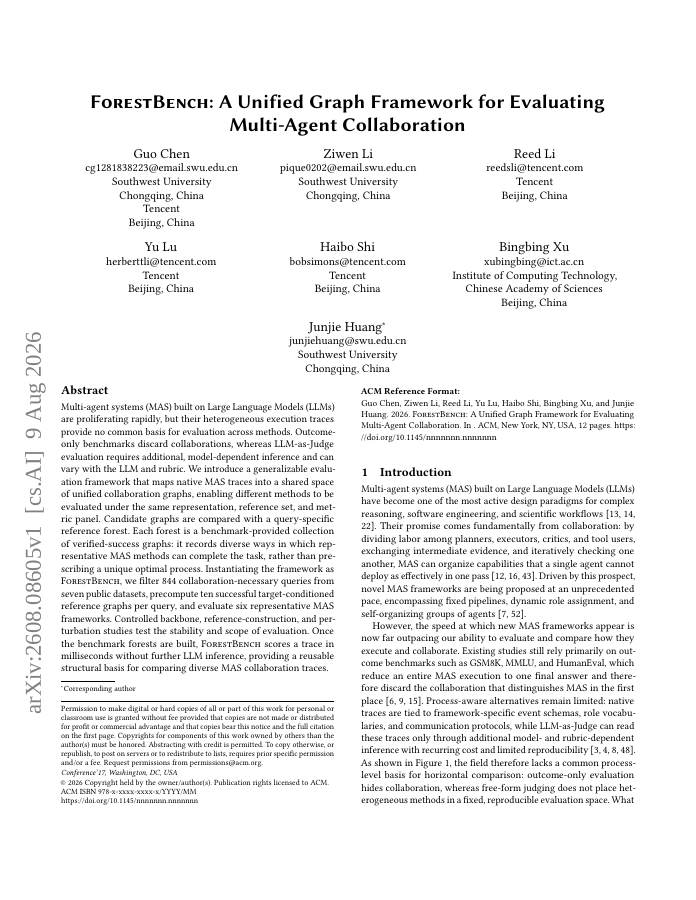
Multi-agent systems (MAS) built on Large Language Models (LLMs) are proliferating rapidly, but their heterogeneous execution traces provide no common basis for evaluation across methods. Outcome-only benchmarks discard collaborations, whereas LLM-as-Judge evaluation requires additional, model-dependent inference and can vary with the LLM and rubric. We introduce a generalizable evaluation framework that maps native MAS traces into a shared space of unified collaboration graphs, enabling different methods to be evaluated under the same representation, reference set, and metric panel. Candidate graphs are compared with a query-specific reference forest. Each forest is a benchmark-provided collection of verified-success graphs: it records diverse ways in which representative MAS methods can complete the task, rather than prescribing a unique optimal process. Instantiating the framework as ForestBench, we filter 844 collaboration-necessary queries from seven public datasets, precompute ten successful target-conditioned reference graphs per query, and evaluate six representative MAS frameworks. Controlled backbone, reference-construction, and perturbation studies test the stability and scope of evaluation. Once the benchmark forests are built, ForestBench scores a trace in milliseconds without further LLM inference, providing a reusable structural basis for comparing diverse MAS collaboration traces.
ForestBench: A Unified Graph Framework for Evaluating Multi-Agent Collaboration
Multi-agent systems (MAS) built on Large Language Models (LLMs) are proliferating rapidly, but their heterogeneous execution traces provide no common basis for evaluation across methods.
- Preview
- Year
- 2026
- Hosting
- Full text hostedCC-BY-4.0
Cite
Notes
Only stored in your browser.
Attribution
- Abstract & full text
- arxiv.org/abs/2608.08605CC-BY-4.0
- TL;DR
- Semantic Scholar