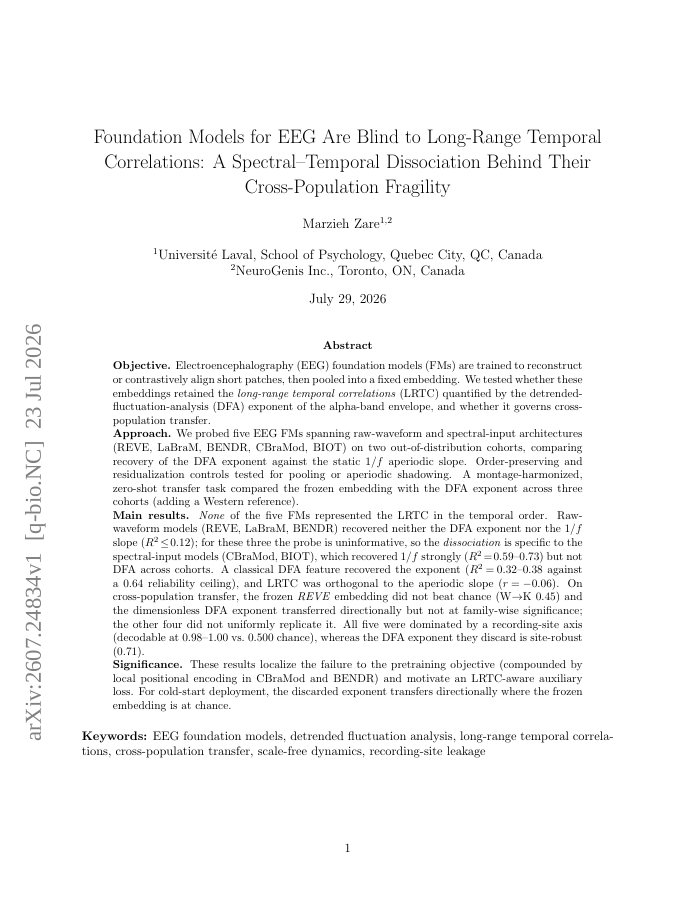
Objective. Electroencephalography (EEG) foundation models (FMs) are trained to reconstruct or contrastively align short patches, then pooled into a fixed embedding. We tested whether these embeddings retained the long-range temporal correlations (LRTC) quantified by the detrended-fluctuation-analysis (DFA) exponent of the alpha-band envelope, and whether it governs cross-population transfer. Approach. We probed five EEG FMs spanning raw-waveform and spectral-input architectures (REVE, LaBraM, BENDR, CBraMod, BIOT) on two out-of-distribution cohorts, comparing recovery of the DFA exponent against the static 1/f aperiodic slope. Order-preserving and residualization controls tested for pooling or aperiodic shadowing. A montage-harmonized, zero-shot transfer task compared the frozen embedding with the DFA exponent across three cohorts (adding a Western reference). Main results. None of the five FMs represented the LRTC in the temporal order. Raw-waveform models (REVE, LaBraM, BENDR) recovered neither the DFA exponent nor the 1/f slope (R^2 <= 0.12); for these three the probe is uninformative, so the dissociation is specific to the spectral-input models (CBraMod, BIOT), which recovered 1/f strongly (R^2 = 0.59-0.73) but not DFA across cohorts. A classical DFA feature recovered the exponent (R^2 = 0.32-0.38 against a 0.64 reliability ceiling), and LRTC was orthogonal to the aperiodic slope (r = -0.06). On cross-population transfer, the frozen REVE embedding did not beat chance (W to K, 0.45) and the dimensionless DFA exponent transferred directionally but not at family-wise significance; the other four did not uniformly replicate it. All five were dominated by a recording-site axis (decodable at 0.98-1.00 vs. 0.500 chance), whereas the DFA exponent they discard is site-robust (0.71).
Foundation Models for EEG Are Blind to Long-Range Temporal Correlations: A Spectral-Temporal Dissociation Behind Their Cross-Population Fragility
Objective. Electroencephalography (EEG) foundation models (FMs) are trained to reconstruct or contrastively align short patches, then pooled into a fixed embedding. We tested whether these embeddings retained the long-range temporal correlations (LRTC) quantified by the…
- Preview
- Year
- 2026
- Hosting
- Abstract onlyARXIV-DEFAULT
Cite
Notes
Only stored in your browser.
Attribution
- Abstract & full text
- arxiv.org/abs/2607.24834ARXIV-DEFAULT
- TL;DR
- Semantic Scholar