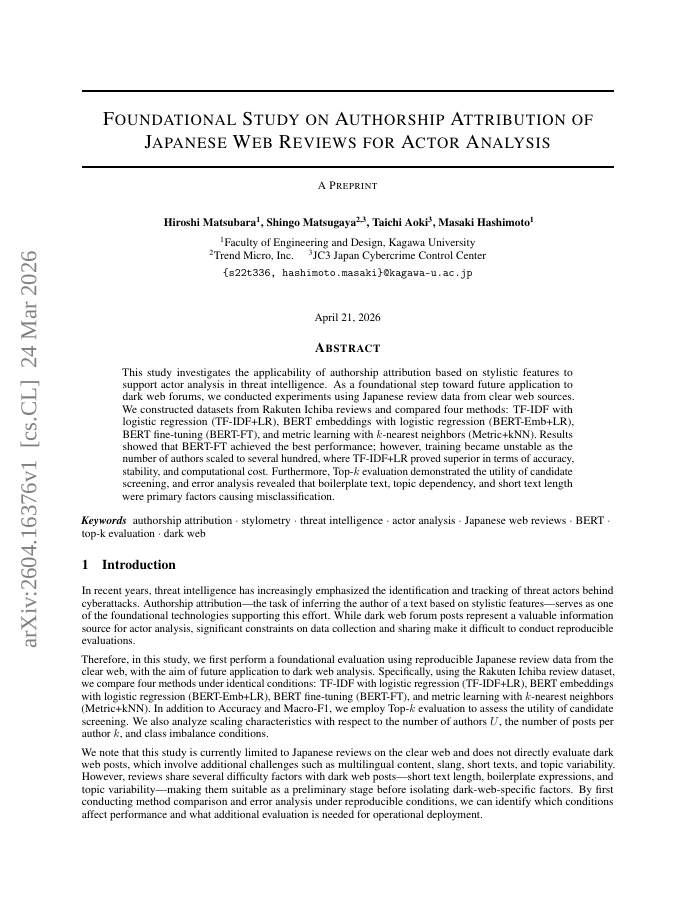
This study investigates the applicability of authorship attribution based on stylistic features to support actor analysis in threat intelligence. As a foundational step toward future application to dark web forums, we conducted experiments using Japanese review data from clear web sources. We constructed datasets from Rakuten Ichiba reviews and compared four methods: TF-IDF with logistic regression (TF-IDF+LR), BERT embeddings with logistic regression (BERT-Emb+LR), BERT fine-tuning (BERT-FT), and metric learning with k-nearest neighbors (Metric+kNN). Results showed that BERT-FT achieved the best performance; however, training became unstable as the number of authors scaled to several hundred, where TF-IDF+LR proved superior in terms of accuracy, stability, and computational cost. Furthermore, Top-k evaluation demonstrated the utility of candidate screening, and error analysis revealed that boilerplate text, topic dependency, and short text length were primary factors causing misclassification.
Foundational Study on Authorship Attribution of Japanese Web Reviews for Actor Analysis
This study investigates the applicability of authorship attribution based on stylistic features to support actor analysis in threat intelligence. As a foundational step toward future application to dark web forums, we conducted experiments using Japanese review data from clear…
- Preview
- Year
- 2026
- Hosting
- Abstract onlyARXIV-DEFAULT
Cite
Notes
Only stored in your browser.
Attribution
- Abstract & full text
- arxiv.org/abs/2604.16376ARXIV-DEFAULT
- TL;DR
- Semantic Scholar