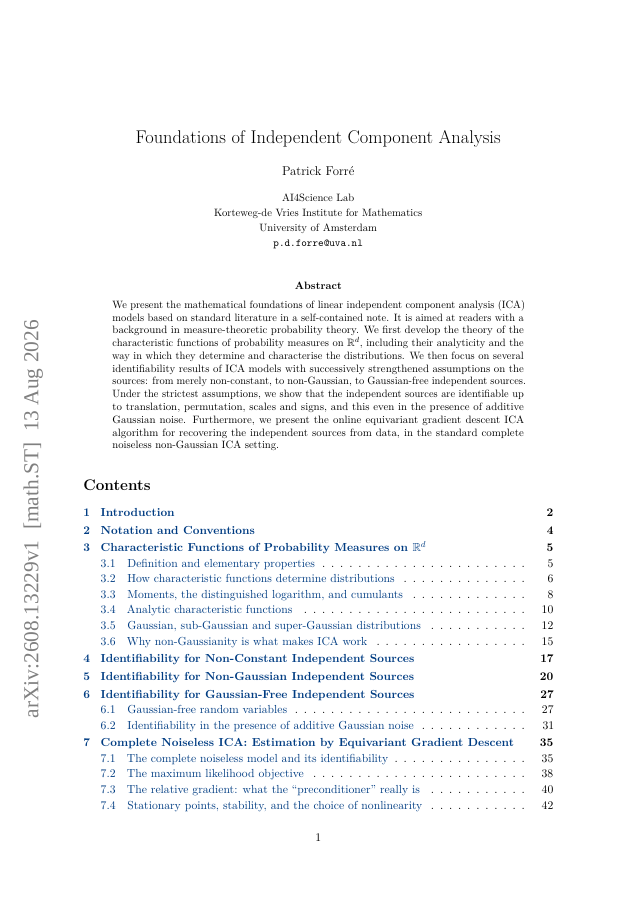
We present the mathematical foundations of linear independent component analysis (ICA) models based on standard literature in a self-contained note. It is aimed at readers with a background in measure-theoretic probability theory. We first develop the theory of the characteristic functions of probability measures on \mathbb{R}^d, including their analyticity and the way in which they determine and characterise the distributions. We then focus on several identifiability results of ICA models with successively strengthened assumptions on the sources: from merely non-constant, to non-Gaussian, to Gaussian-free independent sources. Under the strictest assumptions, we show that the independent sources are identifiable up to translation, permutation, scales and signs, and this even in the presence of additive Gaussian noise. Furthermore, we present the online equivariant gradient descent ICA algorithm for recovering the independent sources from data, in the standard complete noiseless non-Gaussian ICA setting.
Foundations of Independent Component Analysis
We present the mathematical foundations of linear independent component analysis (ICA) models based on standard literature in a self-contained note. It is aimed at readers with a background in measure-theoretic probability theory.
- Preview
- Year
- 2026
- Hosting
- Full text hostedCC-BY-4.0
Cite
Notes
Only stored in your browser.
Attribution
- Abstract & full text
- arxiv.org/abs/2608.13229CC-BY-4.0
- TL;DR
- Semantic Scholar