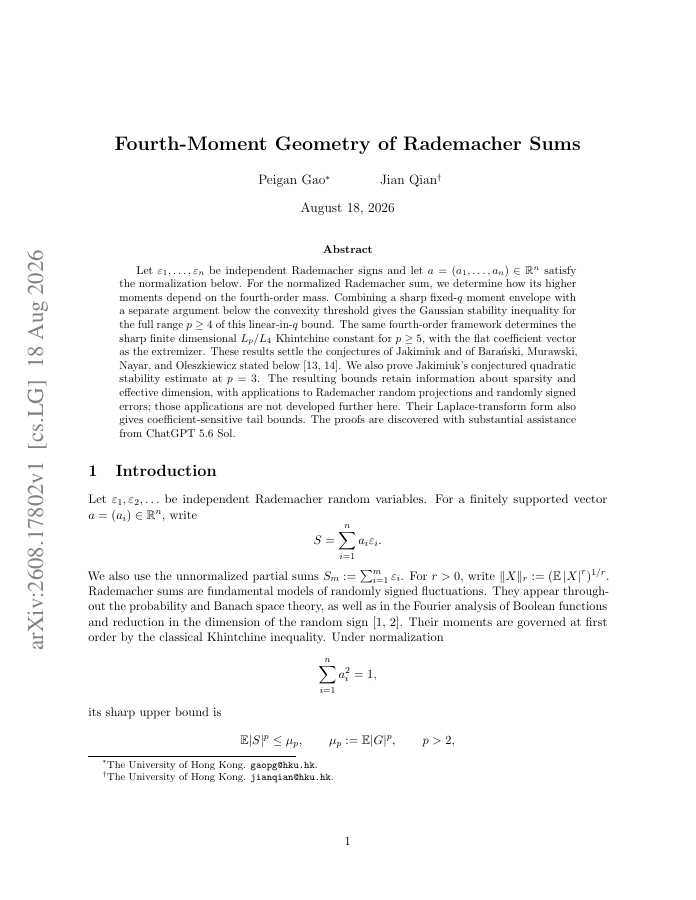
Let \varepsilon_1,\ldots,\varepsilon_n be independent Rademacher signs and let a=(a_1,\ldots,a_n)\in\R^n satisfy the normalization below. For the normalized Rademacher sum, we determine how its higher moments depend on the fourth-order mass. Combining a sharp fixed-q moment envelope with a separate argument below the convexity threshold gives the Gaussian stability inequality for the full range p\geq4 of this linear-in-q bound. The same fourth-order framework determines the sharp finite dimensional L_p/L_4 Khintchine constant for p\geq5, with the flat coefficient vector as the extremizer. These results settle the conjectures of Jakimiuk and of Barański, Murawski, Nayar, and Oleszkiewicz stated below. We also prove Jakimiuk's conjectured quadratic stability estimate at p=3. The resulting bounds retain information about sparsity and effective dimension, with applications to Rademacher random projections and randomly signed errors; those applications are not developed further here. Their Laplace-transform form also gives coefficient-sensitive tail bounds. The proofs are discovered with substantial assistance from ChatGPT 5.6 Sol.
Fourth-Moment Geometry of Rademacher Sums
Let $\varepsilon_1,\ldots,\varepsilon_n$ be independent Rademacher signs and let $a=(a_1,\ldots,a_n)\in\R^n$ satisfy the normalization below. For the normalized Rademacher sum, we determine how its higher moments depend on the fourth-order mass.
- Preview
- Year
- 2026
- Hosting
- Abstract onlyARXIV-DEFAULT
Cite
Notes
Only stored in your browser.
Attribution
- Abstract & full text
- arxiv.org/abs/2608.17802ARXIV-DEFAULT
- TL;DR
- Semantic Scholar