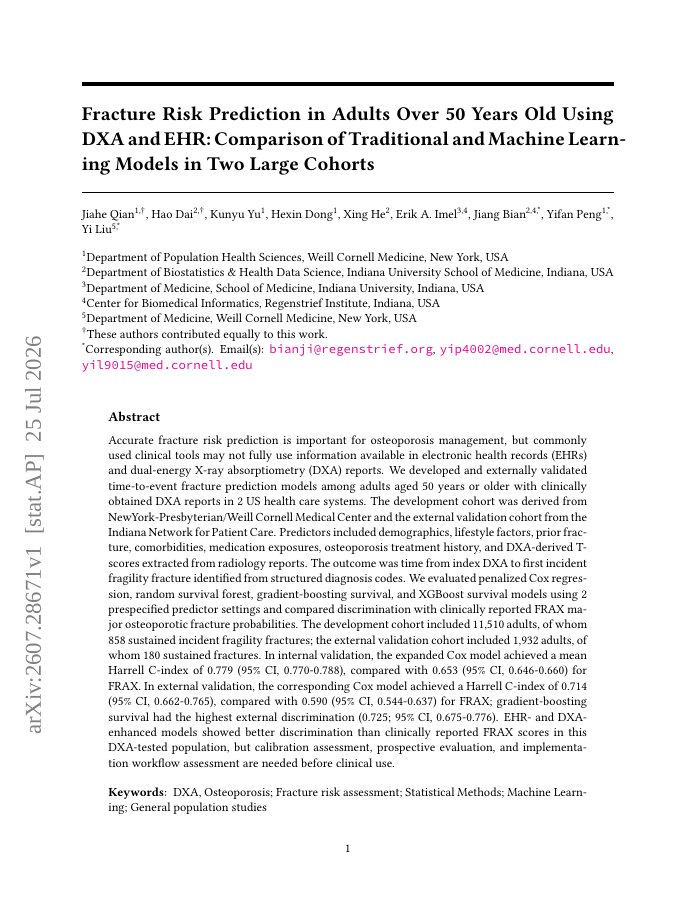
Accurate fracture risk prediction is important for osteoporosis management, but commonly used clinical tools may not fully use information available in electronic health records (EHRs) and dual-energy X-ray absorptiometry (DXA) reports. We developed and externally validated time-to-event fracture prediction models among adults aged 50 years or older with clinically obtained DXA reports in 2 US health care systems. The development cohort was derived from NewYork-Presbyterian/Weill Cornell Medical Center and the external validation cohort from the Indiana Network for Patient Care. Predictors included demographics, lifestyle factors, prior fracture, comorbidities, medication exposures, osteoporosis treatment history, and DXA-derived T-scores extracted from radiology reports. The outcome was time from index DXA to first incident fragility fracture identified from structured diagnosis codes. We evaluated penalized Cox regression, random survival forest, gradient-boosting survival, and XGBoost survival models using 2 prespecified predictor settings and compared discrimination with clinically reported FRAX major osteoporotic fracture probabilities. The development cohort included 11,510 adults, of whom 858 sustained incident fragility fractures; the external validation cohort included 1,932 adults, of whom 180 sustained fractures. In internal validation, the expanded Cox model achieved a mean Harrell C-index of 0.779, compared with 0.653 for FRAX. In external validation, the corresponding Cox model achieved a Harrell C-index of 0.714, compared with 0.590 for FRAX; gradient-boosting survival had the highest external discrimination (0.725). EHR- and DXA-enhanced models showed better discrimination than clinically reported FRAX scores in this DXA-tested population, but calibration assessment, prospective evaluation, and implementation workflow assessment are needed before clinical use.
Fracture Risk Prediction in Adults Over 50 Years Old Using DXA and EHR: Comparison of Traditional and Machine Learning Models in Two Large Cohorts
Accurate fracture risk prediction is important for osteoporosis management, but commonly used clinical tools may not fully use information available in electronic health records (EHRs) and dual-energy X-ray absorptiometry (DXA) reports.
- Preview
- Year
- 2026
- Hosting
- Full text hostedCC-BY-4.0
Cite
Notes
Only stored in your browser.
Attribution
- Abstract & full text
- arxiv.org/abs/2607.28671CC-BY-4.0
- TL;DR
- Semantic Scholar