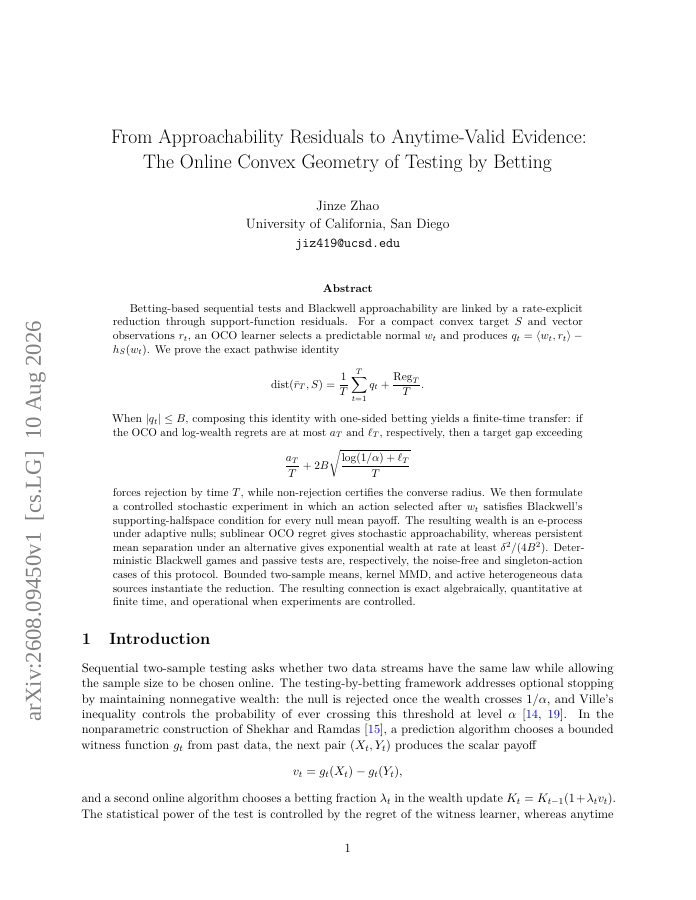
Betting-based sequential tests and Blackwell approachability are linked by a rate-explicit reduction through support-function residuals. For a compact convex target S and vector observations r_t, an OCO learner selects a predictable normal w_t and produces q_t=\langle w_t,r_t\rangle-h_S(w_t). We prove the exact pathwise identity $ \dist(\bar r_T,S) =\frac1T\sum_{t=1}^Tq_t+\frac{\Reg_T}{T}. When |q_t|\leq B, composing this identity with one-sided betting yields a finite-time transfer: if the OCO and log-wealth regrets are at most a_T and \ell_T, respectively, then a target gap exceeding [ \frac{a_T}{T} +2B\sqrt{\frac{\log(1/α)+\ell_T}{T}} ] forces rejection by time T, while non-rejection certifies the converse radius. We then formulate a controlled stochastic experiment in which an action selected after w_t satisfies Blackwell's supporting-halfspace condition for every null mean payoff. The resulting wealth is an e-process under adaptive nulls; sublinear OCO regret gives stochastic approachability, whereas persistent mean separation under an alternative gives exponential wealth at rate at least δ^2/(4B^2)$. Deterministic Blackwell games and passive tests are, respectively, the noise-free and singleton-action cases of this protocol. Bounded two-sample means, kernel MMD, and active heterogeneous data sources instantiate the reduction. The resulting connection is exact algebraically, quantitative at finite time, and operational when experiments are controlled.
From Approachability Residuals to Anytime-Valid Evidence: The Online Convex Geometry of Testing by Betting
Betting-based sequential tests and Blackwell approachability are linked by a rate-explicit reduction through support-function residuals. For a compact convex target $S$ and vector observations $r_t$, an OCO learner selects a predictable normal $w_t$ and produces $q_t=\langle…
- Preview
- Year
- 2026
- Hosting
- Abstract onlyARXIV-DEFAULT
Cite
Notes
Only stored in your browser.
Attribution
- Abstract & full text
- arxiv.org/abs/2608.09450ARXIV-DEFAULT
- TL;DR
- Semantic Scholar