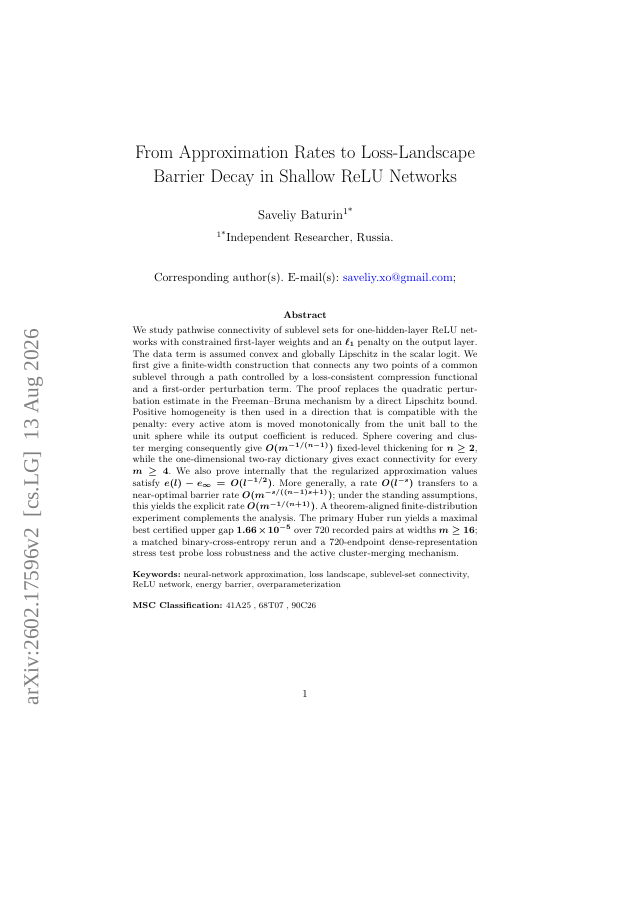
We study pathwise connectivity of sublevel sets for one-hidden-layer ReLU networks with constrained first-layer weights and an \ell_1 penalty on the output layer. The data term is assumed convex and globally Lipschitz in the scalar logit. We first give a finite-width construction that connects any two points of a common sublevel through a path controlled by a loss-consistent compression functional and a first-order perturbation term. The proof replaces the quadratic perturbation estimate in the Freeman--Bruna mechanism by a direct Lipschitz bound. Positive homogeneity is then used in a direction that is compatible with the penalty: every active atom is moved monotonically from the unit ball to the unit sphere while its output coefficient is reduced. Sphere covering and cluster merging consequently give O(m^{-1/(n-1)}) fixed-level thickening for n\ge2, while the one-dimensional two-ray dictionary gives exact connectivity for every m\ge4. We also prove internally that the regularized approximation values satisfy e(l)-e_\infty=O(l^{-1/2}). More generally, a rate O(l^{-s}) transfers to a near-optimal barrier rate O(m^{-s/((n-1)s+1)}); under the standing assumptions, this yields the explicit rate O(m^{-1/(n+1)}). A theorem-aligned finite-distribution experiment complements the analysis. The primary Huber run yields a maximal best certified upper gap 1.66\times10^{-5} over 720 recorded pairs at widths m\ge16; a matched binary-cross-entropy rerun and a 720-endpoint dense-representation stress test probe loss robustness and the active cluster-merging mechanism.
From Approximation Rates to Loss-Landscape Barrier Decay in Shallow ReLU Networks
We study pathwise connectivity of sublevel sets for one-hidden-layer ReLU networks with constrained first-layer weights and an $\ell_1$ penalty on the output layer. The data term is assumed convex and globally Lipschitz in the scalar logit.
- Preview
- Year
- 2026
- Hosting
- Full text hostedCC-BY-4.0
Cite
Notes
Only stored in your browser.
Attribution
- Abstract & full text
- arxiv.org/abs/2602.17596CC-BY-4.0
- TL;DR
- Semantic Scholar