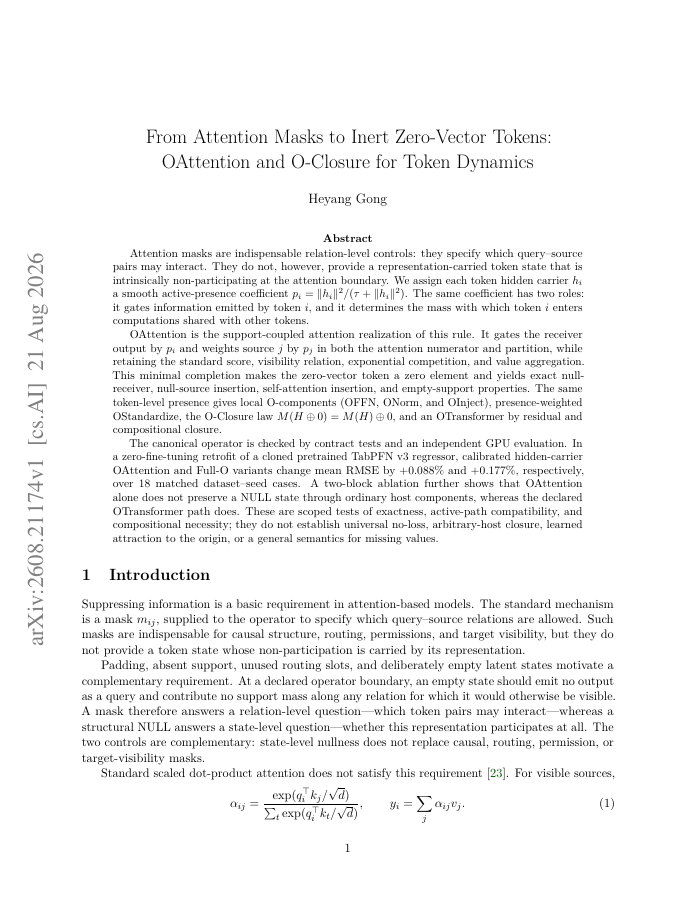
Attention masks are relation-level controls: they specify which query--source pairs may interact. They do not provide a representation-carried token state that is non-participating at the attention boundary. We assign each token hidden carrier h_i an active-presence coefficient p_i=\lVert h_i\rVert^2/(τ+\lVert h_i\rVert^2). The same coefficient has two roles: it gates information emitted by token i, and it determines the mass with which token i enters computations shared with other tokens. OAttention is the support-coupled attention realization of this rule. It gates the receiver output by p_i and weights source j by p_j in both the attention numerator and partition, while retaining the standard score, visibility relation, exponential competition, and value aggregation. This makes the zero-vector token a zero element and yields exact null-receiver, null-source insertion, self-attention insertion, and empty-support properties. The same token-level presence gives local O-components (OFFN, ONorm, and OInject), presence-weighted OStandardize, the O-Closure law M(H\oplus0)=M(H)\oplus0, and an OTransformer by residual and compositional closure. The canonical operator is checked by contract tests and a GPU evaluation. In a zero-fine-tuning retrofit of a cloned pretrained TabPFN v3 regressor, calibrated hidden-carrier OAttention and Full-O variants change mean RMSE by +0.088% and +0.177%, respectively, over 18 matched dataset--seed cases. A two-block ablation shows that OAttention alone does not preserve a NULL state through ordinary host components, whereas the OTransformer path does. These are scoped tests of exactness, active-path compatibility, and compositional necessity; they do not establish universal no-loss, arbitrary-host closure, learned attraction to the origin, or a general semantics for missing values.
From Attention Masks to Inert Zero-Vector Tokens: OAttention and O-Closure for Token Dynamics
Attention masks are relation-level controls: they specify which query--source pairs may interact. They do not provide a representation-carried token state that is non-participating at the attention boundary.
- Preview
- Year
- 2026
- Hosting
- Full text hostedCC-BY-4.0
Cite
Notes
Only stored in your browser.
Attribution
- Abstract & full text
- arxiv.org/abs/2608.21174CC-BY-4.0
- TL;DR
- Semantic Scholar