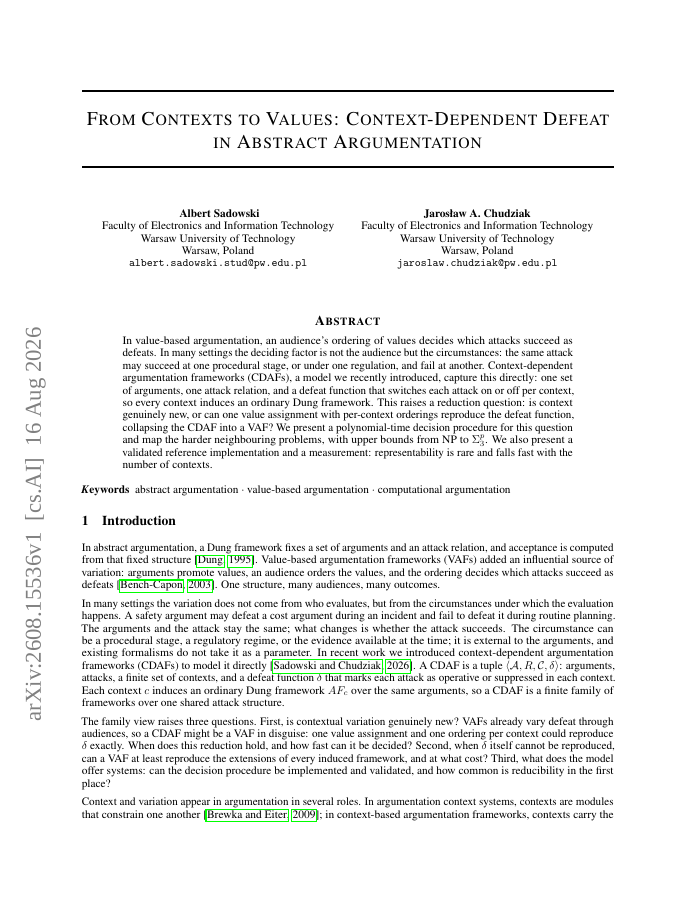
In value-based argumentation, an audience's ordering of values decides which attacks succeed as defeats. In many settings the deciding factor is not the audience but the circumstances: the same attack may succeed at one procedural stage, or under one regulation, and fail at another. Context-dependent argumentation frameworks (CDAFs), a model we recently introduced, capture this directly: one set of arguments, one attack relation, and a defeat function that switches each attack on or off per context, so every context induces an ordinary Dung framework. This raises a reduction question: is context genuinely new, or can one value assignment with per-context orderings reproduce the defeat function, collapsing the CDAF into a VAF? We present a polynomial-time decision procedure for this question and map the harder neighbouring problems, with upper bounds from NP to Σ^p_3. We also present a validated reference implementation and a measurement: representability is rare and falls fast with the number of contexts.
From Contexts to Values: Context-Dependent Defeat in Abstract Argumentation
In value-based argumentation, an audience's ordering of values decides which attacks succeed as defeats. In many settings the deciding factor is not the audience but the circumstances: the same attack may succeed at one procedural stage, or under one regulation, and fail at…
- Preview
- Year
- 2026
- Hosting
- Full text hostedCC-BY-4.0
Cite
Notes
Only stored in your browser.
Attribution
- Abstract & full text
- arxiv.org/abs/2608.15536CC-BY-4.0
- TL;DR
- Semantic Scholar