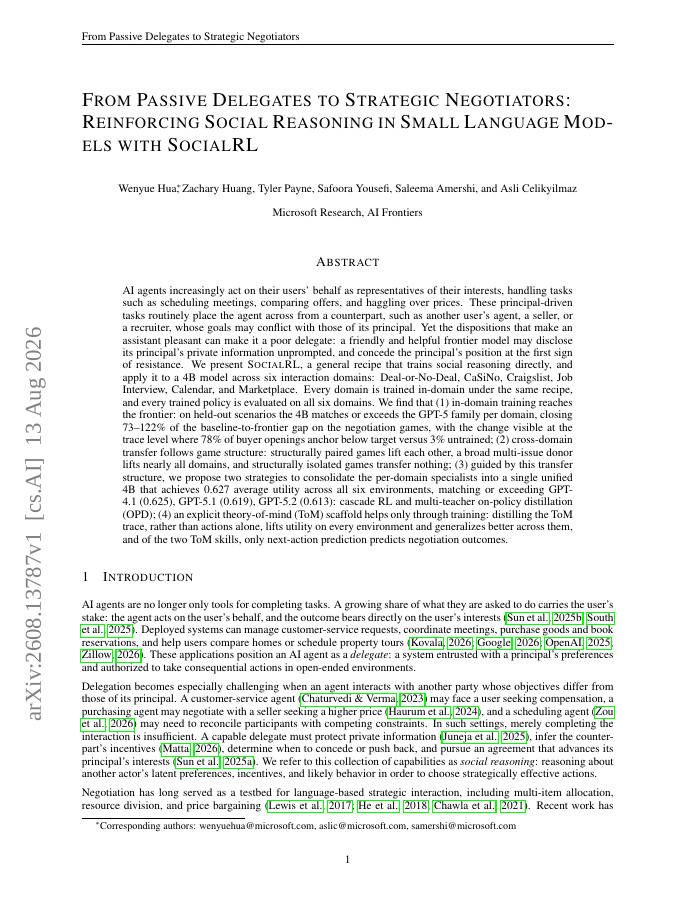
AI agents increasingly act on their users' behalf, handling tasks such as scheduling meetings, comparing offers, and haggling over prices. These principal-driven tasks routinely place the agent across from a counterpart (another user's agent, a seller, a recruiter) whose goals may conflict with its principal's. Yet the dispositions that make an assistant pleasant can make it a poor delegate: a friendly, helpful frontier model may disclose its principal's private information unprompted and concede at the first sign of resistance. We present SocialRL, a general recipe that trains social reasoning directly, and apply it to a 4B model across six domains: Deal-or-No-Deal, CaSiNo, Craigslist, Job Interview, Calendar, and Marketplace. Every domain is trained in-domain under the same recipe, and every policy is evaluated on all six. We find that (1) in-domain training reaches the frontier: on held-out scenarios the 4B matches or exceeds the GPT-5 family per domain, closing 73-122% of the baseline-to-frontier gap on the negotiation games, with 78% of buyer openings anchoring below target versus 3% untrained; (2) cross-domain transfer follows game structure: structurally paired games lift each other, a broad multi-issue donor lifts nearly all domains, and structurally isolated games transfer nothing; (3) guided by this transfer structure, two strategies, cascade RL and multi-teacher on-policy distillation (OPD), consolidate the per-domain specialists into a single unified 4B that reaches 0.627 average utility across all six environments, matching or exceeding GPT-4.1 (0.625), GPT-5.1 (0.619), and GPT-5.2 (0.613); (4) an explicit theory-of-mind scaffold helps only through training: distilling the ToM trace, rather than actions alone, lifts utility on every environment and generalizes better across them, and of the two ToM skills, only next-action prediction predicts negotiation outcomes.
From Passive Delegates to Strategic Negotiators: Reinforcing Social Reasoning in Small Language Models with SocialRL
AI agents increasingly act on their users' behalf, handling tasks such as scheduling meetings, comparing offers, and haggling over prices. These principal-driven tasks routinely place the agent across from a counterpart (another user's agent, a seller, a recruiter) whose goals…
- Preview
- Year
- 2026
- Hosting
- Full text hostedCC-BY-4.0
Cite
Notes
Only stored in your browser.
Attribution
- Abstract & full text
- arxiv.org/abs/2608.13787CC-BY-4.0
- TL;DR
- Semantic Scholar