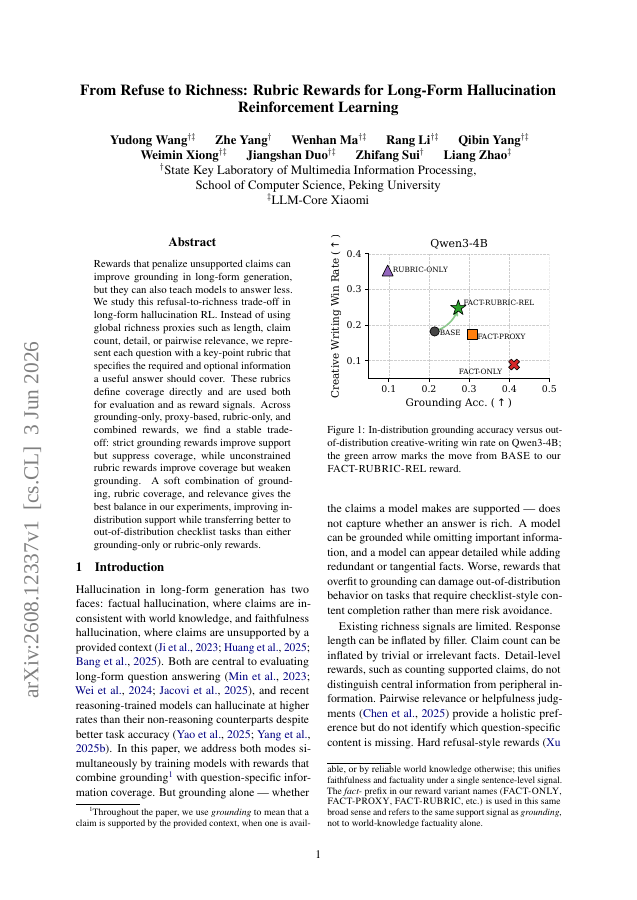
Rewards that penalize unsupported claims can improve grounding in long-form generation, but they can also teach models to answer less. We study this refusal-to-richness trade-off in long-form hallucination RL. Instead of using global richness proxies such as length, claim count, detail, or pairwise relevance, we represent each question with a key-point rubric that specifies the required and optional information a useful answer should cover. These rubrics define coverage directly and are used both for evaluation and as reward signals. Across grounding-only, proxy-based, rubric-only, and combined rewards, we find a stable trade-off: strict grounding rewards improve support but suppress coverage, while unconstrained rubric rewards improve coverage but weaken grounding. A soft combination of grounding, rubric coverage, and relevance gives the best balance in our experiments, improving in-distribution support while transferring better to out-of-distribution checklist tasks than either grounding-only or rubric-only rewards.
From Refuse to Richness: Rubric Rewards for Long-Form Hallucination Reinforcement Learning
Rewards that penalize unsupported claims can improve grounding in long-form generation, but they can also teach models to answer less. We study this refusal-to-richness trade-off in long-form hallucination RL.
- Preview
- Year
- 2026
- Hosting
- Full text hostedCC-BY-4.0
Cite
Notes
Only stored in your browser.
Attribution
- Abstract & full text
- arxiv.org/abs/2608.12337CC-BY-4.0
- TL;DR
- Semantic Scholar