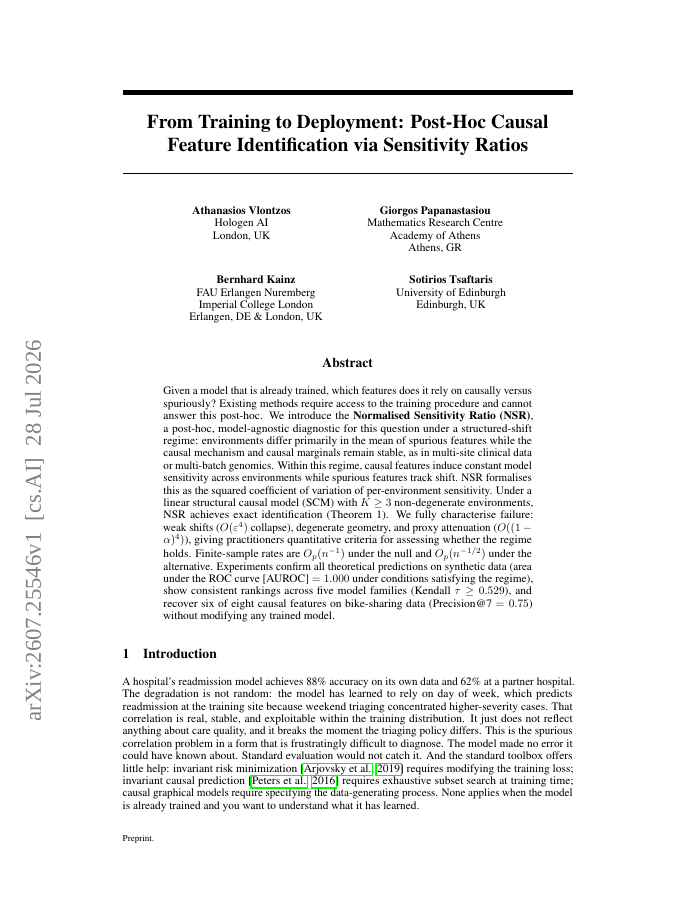
Given a model that is already trained, which features does it rely on causally versus spuriously? Existing methods require access to the training procedure and cannot answer this post-hoc. We introduce the Normalised Sensitivity Ratio (NSR), a post-hoc, model-agnostic diagnostic for this question under a structured-shift regime: environments differ primarily in the mean of spurious features while the causal mechanism and causal marginals remain stable, as in multi-site clinical data or multi-batch genomics. Within this regime, causal features induce constant model sensitivity across environments while spurious features track shift. NSR formalises this as the squared coefficient of variation of per-environment sensitivity. Under a linear structural causal model (SCM) with K\ge3 non-degenerate environments, NSR achieves exact identification (Theorem 1). We fully characterise failure: weak shifts (O(\varepsilon^4) collapse), degenerate geometry, and proxy attenuation (O((1-α)^4)), giving practitioners quantitative criteria for assessing whether the regime holds. Finite-sample rates are O_p(n^{-1}) under the null and O_p(n^{-1/2}) under the alternative. Experiments confirm all theoretical predictions on synthetic data (area under the ROC curve [AUROC] = 1.000 under conditions satisfying the regime), show consistent rankings across five model families (Kendall τ\ge0.529), and recover six of eight causal features on bike-sharing data (Precision@7 = 0.75) without modifying any trained model.
From Training to Deployment: Post-Hoc Causal Feature Identification via Sensitivity Ratios
Given a model that is already trained, which features does it rely on causally versus spuriously? Existing methods require access to the training procedure and cannot answer this post-hoc.
- Preview
- Year
- 2026
- Hosting
- Full text hostedCC-BY-4.0
Cite
Notes
Only stored in your browser.
Attribution
- Abstract & full text
- arxiv.org/abs/2607.25546CC-BY-4.0
- TL;DR
- Semantic Scholar