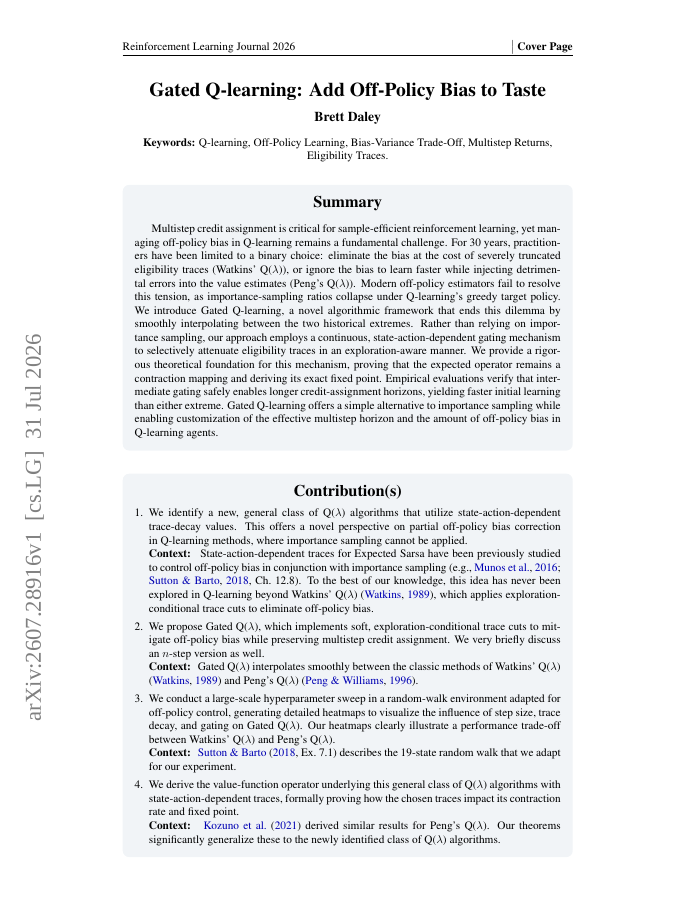
Multistep credit assignment is critical for sample-efficient reinforcement learning, yet managing off-policy bias in Q-learning remains a fundamental challenge. For 30 years, practitioners have been limited to a binary choice: eliminate the bias at the cost of severely truncated eligibility traces (Watkins' Q(λ)), or ignore the bias to learn faster while injecting detrimental errors into the value estimates (Peng's Q(λ)). Modern off-policy estimators fail to resolve this tension, as importance-sampling ratios collapse under Q-learning's greedy target policy. We introduce Gated Q-learning, a novel algorithmic framework that ends this dilemma by smoothly interpolating between the two historical extremes. Rather than relying on importance sampling, our approach employs a continuous, state-action-dependent gating mechanism to selectively attenuate eligibility traces in an exploration-aware manner. We provide a rigorous theoretical foundation for this mechanism, proving that the expected operator remains a contraction mapping and deriving its exact fixed point. Empirical evaluations verify that intermediate gating safely enables longer credit-assignment horizons, yielding faster initial learning than either extreme. Gated Q-learning offers a simple alternative to importance sampling while enabling customization of the effective multistep horizon and the amount of off-policy bias in Q-learning agents.
Gated Q-learning: Add Off-Policy Bias to Taste
Multistep credit assignment is critical for sample-efficient reinforcement learning, yet managing off-policy bias in Q-learning remains a fundamental challenge. For 30 years, practitioners have been limited to a binary choice: eliminate the bias at the cost of severely truncated…
- Preview
- Year
- 2026
- Hosting
- Full text hostedCC-BY-4.0
Cite
Notes
Only stored in your browser.
Attribution
- Abstract & full text
- arxiv.org/abs/2607.28916CC-BY-4.0
- TL;DR
- Semantic Scholar