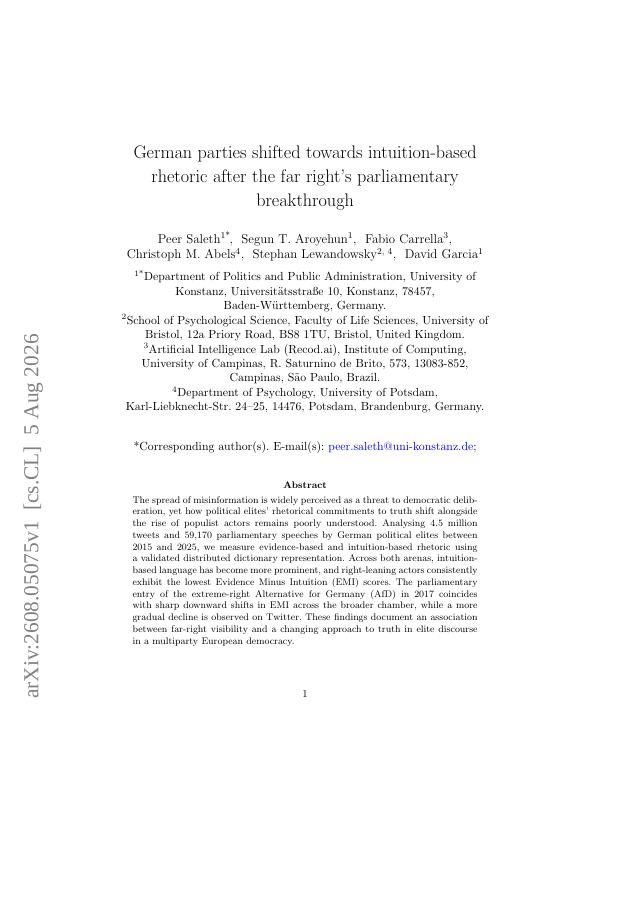
The spread of misinformation is widely perceived as a threat to democratic deliberation, yet how political elites' rhetorical commitments to truth shift alongside the rise of populist actors remains poorly understood. Analysing 4.5 million tweets and 59,170 parliamentary speeches by German political elites between 2015 and 2025, we measure evidence-based and intuition-based rhetoric using a validated distributed dictionary representation. Across both arenas, intuition-based language has become more prominent, and right-leaning actors consistently exhibit the lowest Evidence Minus Intuition (EMI) scores. The parliamentary entry of the extreme-right Alternative for Germany (AfD) in 2017 coincides with sharp downward shifts in EMI across the broader chamber, while a more gradual decline is observed on Twitter. These findings document an association between far-right visibility and a changing approach to truth in elite discourse in a multiparty European democracy.
German parties shifted towards intuition-based rhetoric after the far right's parliamentary breakthrough
The spread of misinformation is widely perceived as a threat to democratic deliberation, yet how political elites' rhetorical commitments to truth shift alongside the rise of populist actors remains poorly understood.
- Preview
- Year
- 2026
- Hosting
- Full text hostedCC-BY-4.0
Cite
Notes
Only stored in your browser.
Attribution
- Abstract & full text
- arxiv.org/abs/2608.05075CC-BY-4.0
- TL;DR
- Semantic Scholar