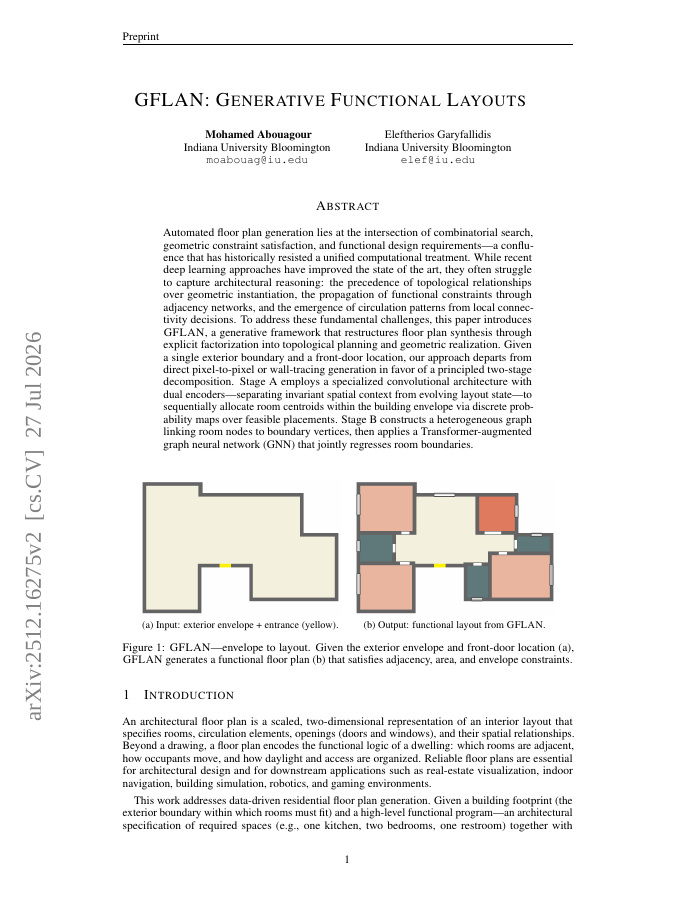
Automated floor plan generation lies at the intersection of combinatorial search, geometric constraint satisfaction, and functional design requirements -- a confluence that has historically resisted a unified computational treatment. While recent deep learning approaches have improved the state of the art, they often struggle to capture architectural reasoning: the precedence of topological relationships over geometric instantiation, the propagation of functional constraints through adjacency networks, and the emergence of circulation patterns from local connectivity decisions. To address these fundamental challenges, this paper introduces GFLAN, a generative framework that restructures floor plan synthesis through explicit factorization into topological planning and geometric realization. Given a single exterior boundary and a front-door location, our approach departs from direct pixel-to-pixel or wall-tracing generation in favor of a principled two-stage decomposition. Stage A employs a specialized convolutional architecture with dual encoders -- separating invariant spatial context from evolving layout state -- to sequentially allocate room centroids within the building envelope via discrete probability maps over feasible placements. Stage B constructs a heterogeneous graph linking room nodes to boundary vertices, then applies a Transformer-augmented graph neural network (GNN) that jointly regresses room boundaries.
GFLAN: Generative Functional Layouts
Automated floor plan generation lies at the intersection of combinatorial search, geometric constraint satisfaction, and functional design requirements -- a confluence that has historically resisted a unified computational treatment.
- Preview
- Year
- 2025
- Hosting
- Abstract onlyARXIV-DEFAULT
Cite
Notes
Only stored in your browser.
Attribution
- Abstract & full text
- arxiv.org/abs/2512.16275ARXIV-DEFAULT
- TL;DR
- Semantic Scholar