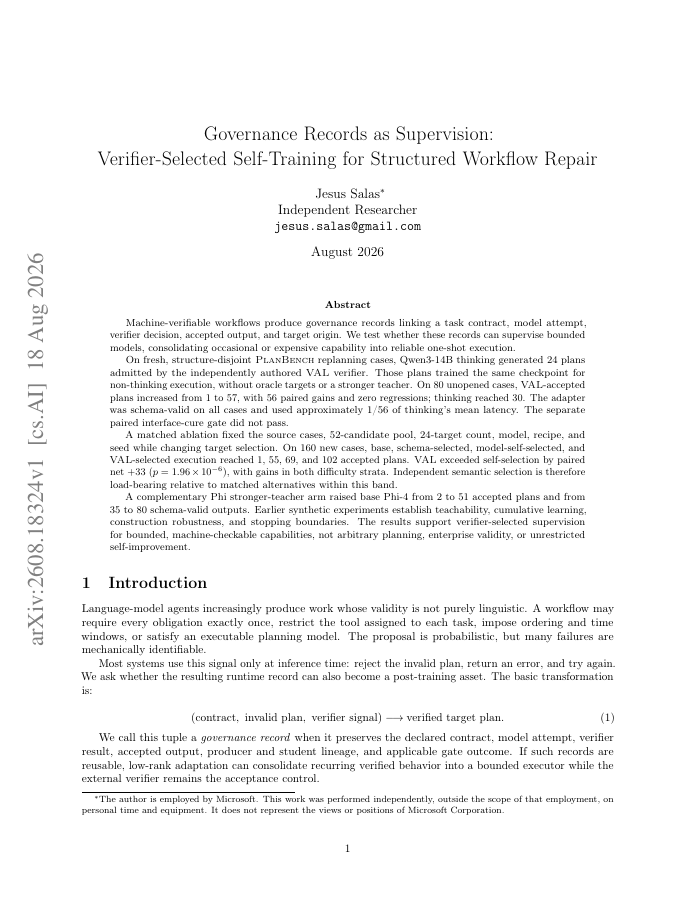
Machine-verifiable workflows produce governance records linking a task contract, model attempt, verifier decision, accepted output, and target origin. We test whether these records can supervise bounded models, consolidating occasional or expensive capability into reliable one-shot execution. On fresh, structure-disjoint PlanBench replanning cases, Qwen3-14B thinking generated 24 plans admitted by the independently authored VAL verifier. Those plans trained the same checkpoint for non-thinking execution, without oracle targets or a stronger teacher. On 80 unopened cases, VAL-accepted plans increased from 1 to 57, with 56 paired gains and zero regressions; thinking reached 30. The adapter was schema-valid on all cases and used approximately 1/56 of thinking's mean latency. The separate paired interface-cure gate did not pass. A matched ablation fixed the source cases, 52-candidate pool, 24-target count, model, recipe, and seed while changing target selection. On 160 new cases, base, schema-selected, model-self-selected, and VAL-selected execution reached 1, 55, 69, and 102 accepted plans. VAL exceeded self-selection by paired net +33 (p=0.0000019647), with gains in both difficulty strata. Independent semantic selection is therefore load-bearing relative to matched alternatives within this band. A complementary Phi stronger-teacher arm raised base Phi-4 from 2 to 51 accepted plans and from 35 to 80 schema-valid outputs. Earlier synthetic experiments establish teachability, cumulative learning, construction robustness, and stopping boundaries. The results support verifier-selected supervision for bounded, machine-checkable capabilities, not arbitrary planning, enterprise validity, or unrestricted self-improvement.
Governance Records as Supervision: Verifier-Selected Self-Training for Structured Workflow Repair
Machine-verifiable workflows produce governance records linking a task contract, model attempt, verifier decision, accepted output, and target origin. We test whether these records can supervise bounded models, consolidating occasional or expensive capability into reliable…
- Preview
- Year
- 2026
- Hosting
- Full text hostedCC-BY-4.0
Cite
Notes
Only stored in your browser.
Attribution
- Abstract & full text
- arxiv.org/abs/2608.18324CC-BY-4.0
- TL;DR
- Semantic Scholar