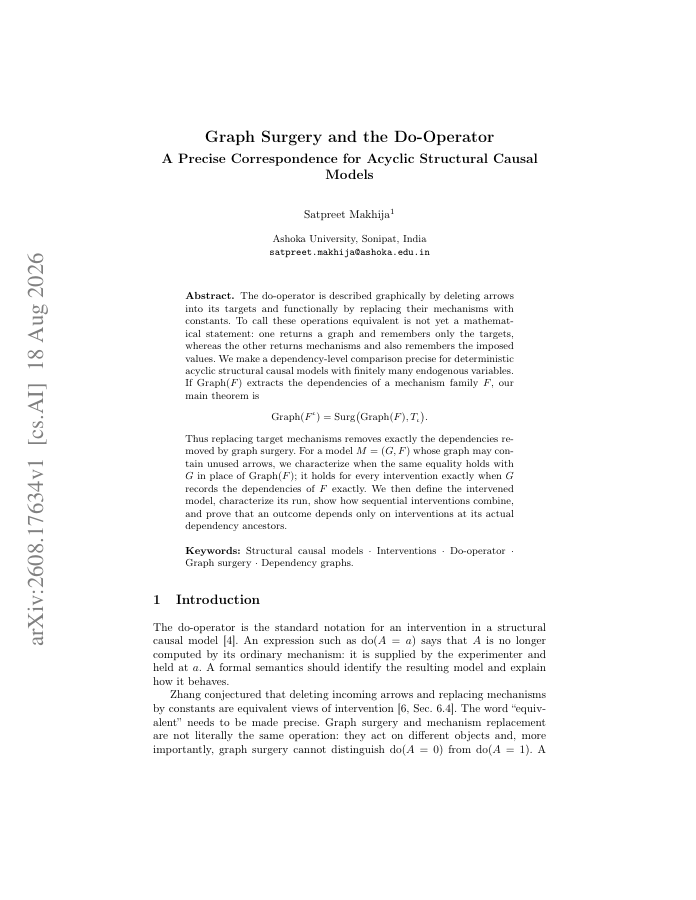
The \operatorname{do}-operator is described graphically by deleting arrows into its targets and functionally by replacing their mechanisms with constants. To call these operations equivalent is not yet a mathematical statement: one returns a graph and remembers only the targets, whereas the other returns mechanisms and also remembers the imposed values. We make a dependency-level comparison precise for deterministic acyclic structural causal models with finitely many endogenous variables. If \operatorname{Graph}(F) extracts the dependencies of a mechanism family F, our main theorem is \operatorname{Graph}(F^ι)=\operatorname{Surg}(\operatorname{Graph}(F),T_ι). Thus replacing target mechanisms removes exactly the dependencies removed by graph surgery. For a model M=(G,F) whose graph may contain unused arrows, we characterize when the same equality holds with G in place of \operatorname{Graph}(F); it holds for every intervention exactly when G records the dependencies of F exactly. We then define the intervened model, characterize its run, show how sequential interventions combine, and prove that an outcome depends only on interventions at its actual dependency ancestors.
Graph Surgery and the Do-Operator: A Precise Correspondence for Acyclic Structural Causal Models
The $\operatorname{do}$-operator is described graphically by deleting arrows into its targets and functionally by replacing their mechanisms with constants. To call these operations equivalent is not yet a mathematical statement: one returns a graph and remembers only the…
- Preview
- Year
- 2026
- Hosting
- Full text hostedCC-BY-4.0
Cite
Notes
Only stored in your browser.
Attribution
- Abstract & full text
- arxiv.org/abs/2608.17634CC-BY-4.0
- TL;DR
- Semantic Scholar