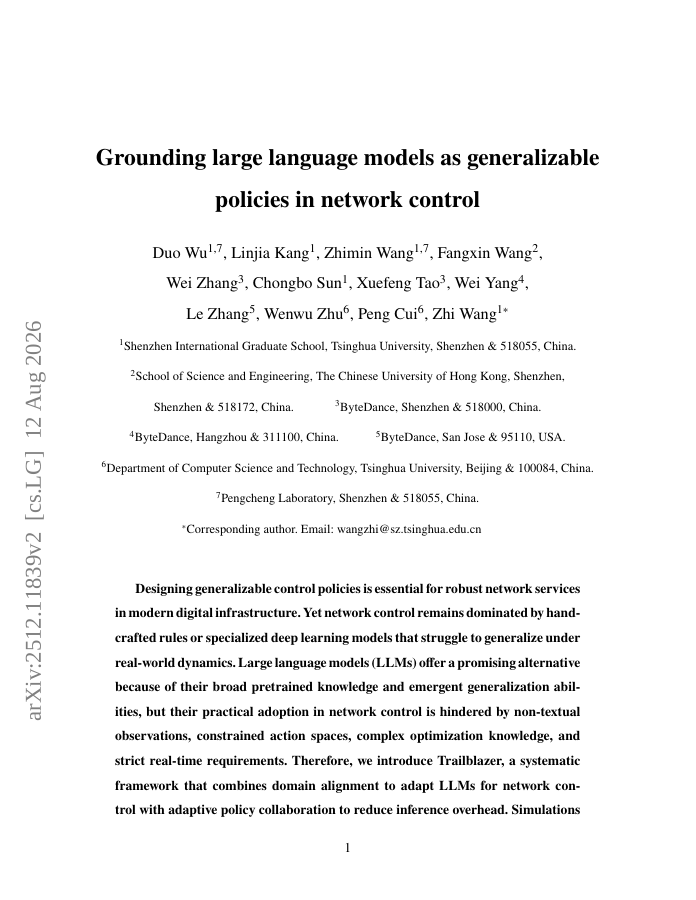
Designing generalizable control policies that operate reliably under changing conditions is essential for robust network services in modern digital infrastructure. Yet network control remains dominated by specialized policies built from handcrafted rules or deep learning models, which struggle to generalize under real-world dynamics. Large language models (LLMs) offer a promising alternative because of their broad pretrained knowledge and emergent generalization abilities, but their practical adoption in network control is hindered by non-textual observations, constrained action spaces, complex optimization knowledge, and strict real-time requirements. Therefore, we introduce Trailblazer, a systematic framework that combines domain alignment to adapt LLMs for network control with adaptive policy collaboration to reduce inference overhead. Simulations across two heterogeneous network control tasks, adaptive bitrate streaming and cluster job scheduling, show that Trailblazer improves performance over conventional policies by 6.5%-36.6% and 3.5%-41.3%, respectively. Moreover, in a large-scale online A/B test of congestion control on Douyin, Trailblazer outperforms a highly optimized industrial policy, corresponding to a projected reduction of approximately 3,145 hours of platform-wide video stall time per day. Further analysis reveals that effective LLM-based control can be achieved by properly aligning compact LLMs and only invoking them for complex conditions, rather than model scaling or extensive invocation. Together, our results establish an LLM-driven paradigm for designing generalizable network policies and offer practical insights into grounding foundation models for real-world network control.
Grounding Large Language Models as Generalizable Policies in Network Control
Designing generalizable control policies that operate reliably under changing conditions is essential for robust network services in modern digital infrastructure. Yet network control remains dominated by specialized policies built from handcrafted rules or deep learning models,…
- Preview
- Year
- 2025
- Hosting
- Full text hostedCC-BY-4.0
Cite
Notes
Only stored in your browser.
Attribution
- Abstract & full text
- arxiv.org/abs/2512.11839CC-BY-4.0
- TL;DR
- Semantic Scholar