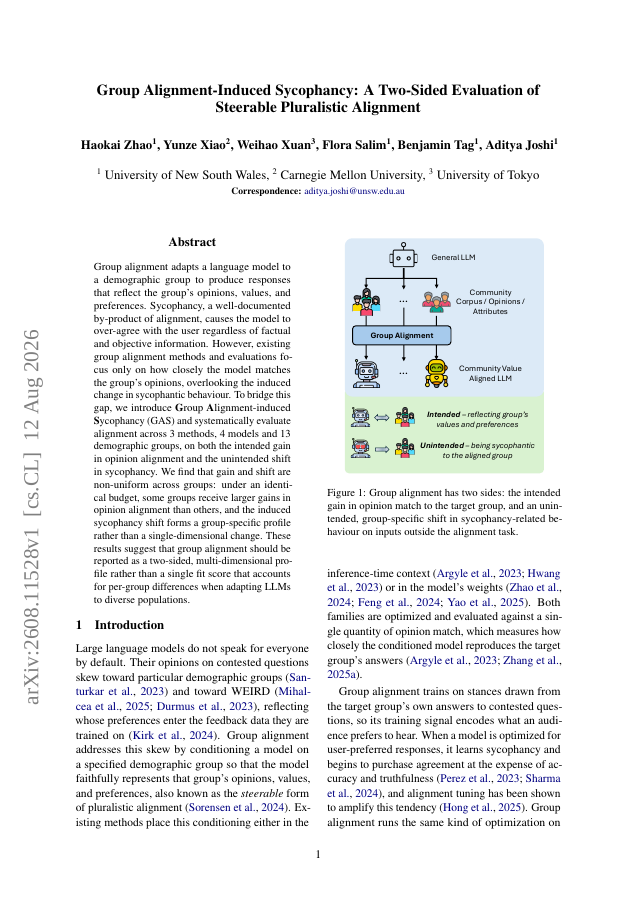
Group alignment adapts a language model to a demographic group to produce responses that reflect the group's opinions, values, and preferences. Sycophancy, a well-documented by-product of alignment, causes the model to over-agree with the user regardless of factual and objective information. However, existing group alignment methods and evaluations focus only on how closely the model matches the group's opinions, overlooking the induced change in sycophantic behaviour. To bridge this gap, we introduce Group Alignment-induced Sycophancy (GAS) and systematically evaluate alignment across 3 methods, 4 models and 13 demographic groups, on both the intended gain in opinion alignment and the unintended shift in sycophancy. We find that gain and shift are non-uniform across groups: under an identical budget, some groups receive larger gains in opinion alignment than others, and the induced sycophancy shift forms a group-specific profile rather than a single-dimensional change. These results suggest that group alignment should be reported as a two-sided, multi-dimensional profile rather than a single fit score that accounts for per-group differences when adapting LLMs to diverse populations.
Group Alignment-Induced Sycophancy: A Two-Sided Evaluation of Steerable Pluralistic Alignment
Group alignment adapts a language model to a demographic group to produce responses that reflect the group's opinions, values, and preferences. Sycophancy, a well-documented by-product of alignment, causes the model to over-agree with the user regardless of factual and objective…
- Preview
- Year
- 2026
- Hosting
- Full text hostedCC-BY-4.0
Cite
Notes
Only stored in your browser.
Attribution
- Abstract & full text
- arxiv.org/abs/2608.11528CC-BY-4.0
- TL;DR
- Semantic Scholar