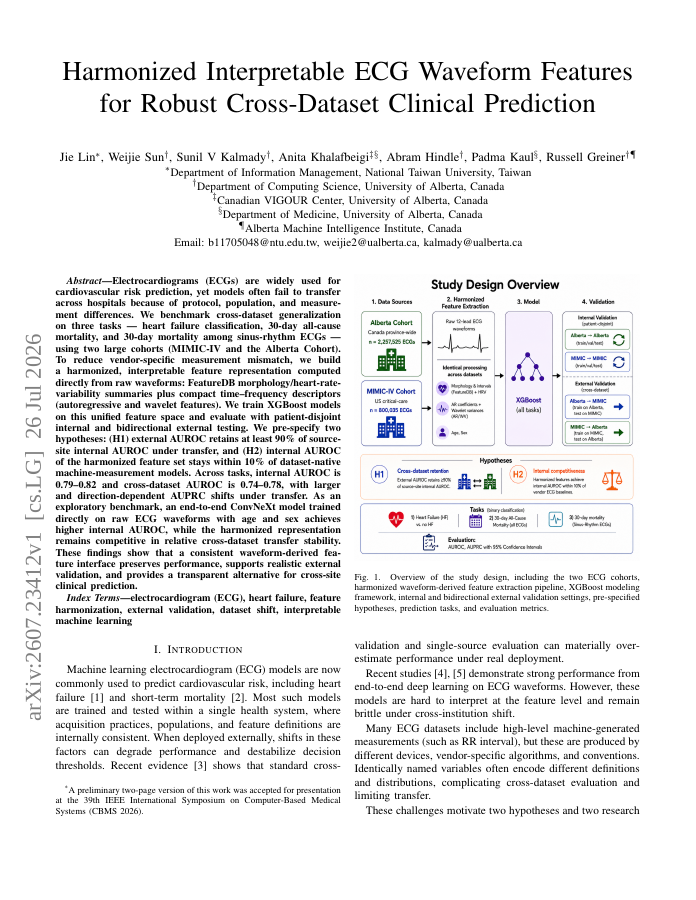
Electrocardiograms (ECGs) are widely used for cardiovascular risk prediction, yet models often fail to transfer across hospitals because of protocol, population, and measurement differences. We benchmark cross-dataset generalization on three tasks - heart failure classification, 30-day all-cause mortality, and 30-day mortality among sinus-rhythm ECGs - using two large cohorts (MIMIC-IV and the Alberta Cohort). To reduce vendor-specific measurement mismatch, we build a harmonized, interpretable feature representation computed directly from raw waveforms: FeatureDB morphology/heart-rate-variability summaries plus compact time-frequency descriptors (autoregressive and wavelet features). We train XGBoost models on this unified feature space and evaluate with patient-disjoint internal and bidirectional external testing. We pre-specify two hypotheses: (H1) external AUROC retains at least 90% of source-site internal AUROC under transfer, and (H2) internal AUROC of the harmonized feature set stays within 10% of dataset-native machine-measurement models. Across tasks, internal AUROC is 0.79-0.82 and cross-dataset AUROC is 0.74-0.78, with larger and direction-dependent AUPRC shifts under transfer. As an exploratory benchmark, an end-to-end ConvNeXt model trained directly on raw ECG waveforms with age and sex achieves higher internal AUROC, while the harmonized representation remains competitive in relative cross-dataset transfer stability. These findings show that a consistent waveform-derived feature interface preserves performance, supports realistic external validation, and provides a transparent alternative for cross-site clinical prediction.
Harmonized Interpretable ECG Waveform Features for Robust Cross-Dataset Clinical Prediction
Electrocardiograms (ECGs) are widely used for cardiovascular risk prediction, yet models often fail to transfer across hospitals because of protocol, population, and measurement differences.
- Preview
- Year
- 2026
- Hosting
- Excerpt onlyCC-BY-NC-SA-4.0
Cite
Notes
Only stored in your browser.
Attribution
- Abstract & full text
- arxiv.org/abs/2607.23412CC-BY-NC-SA-4.0
- TL;DR
- Semantic Scholar