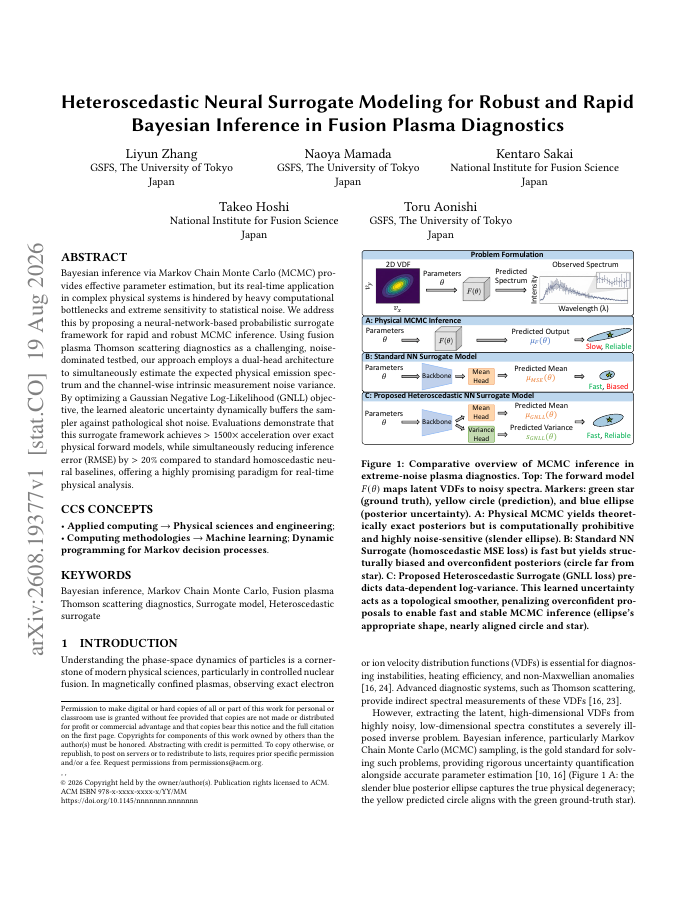
Bayesian inference via Markov Chain Monte Carlo (MCMC) provides effective parameter estimation, but its real-time application in complex physical systems is hindered by heavy computational bottlenecks and extreme sensitivity to statistical noise. We address this by proposing a neural-network-based probabilistic surrogate framework for rapid and robust MCMC inference. Using fusion plasma Thomson scattering diagnostics as a challenging, noise-dominated testbed, our approach employs a dual-head architecture to simultaneously estimate the expected physical emission spectrum and the channel-wise intrinsic measurement noise variance. By optimizing a Gaussian Negative Log-Likelihood (GNLL) objective, the learned aleatoric uncertainty dynamically buffers the sampler against pathological shot noise. Evaluations demonstrate that this surrogate framework achieves > 1500x acceleration over exact physical forward models, while simultaneously reducing inference error (RMSE) by >20% compared to standard homoscedastic neural baselines, offering a highly promising paradigm for real-time physical analysis.
Heteroscedastic Neural Surrogate Modeling for Robust and Rapid Bayesian Inference in Fusion Plasma Diagnostics
Bayesian inference via Markov Chain Monte Carlo (MCMC) provides effective parameter estimation, but its real-time application in complex physical systems is hindered by heavy computational bottlenecks and extreme sensitivity to statistical noise.
- Preview
- Year
- 2026
- Hosting
- Abstract onlyARXIV-DEFAULT
Cite
Notes
Only stored in your browser.
Attribution
- Abstract & full text
- arxiv.org/abs/2608.19377ARXIV-DEFAULT
- TL;DR
- Semantic Scholar