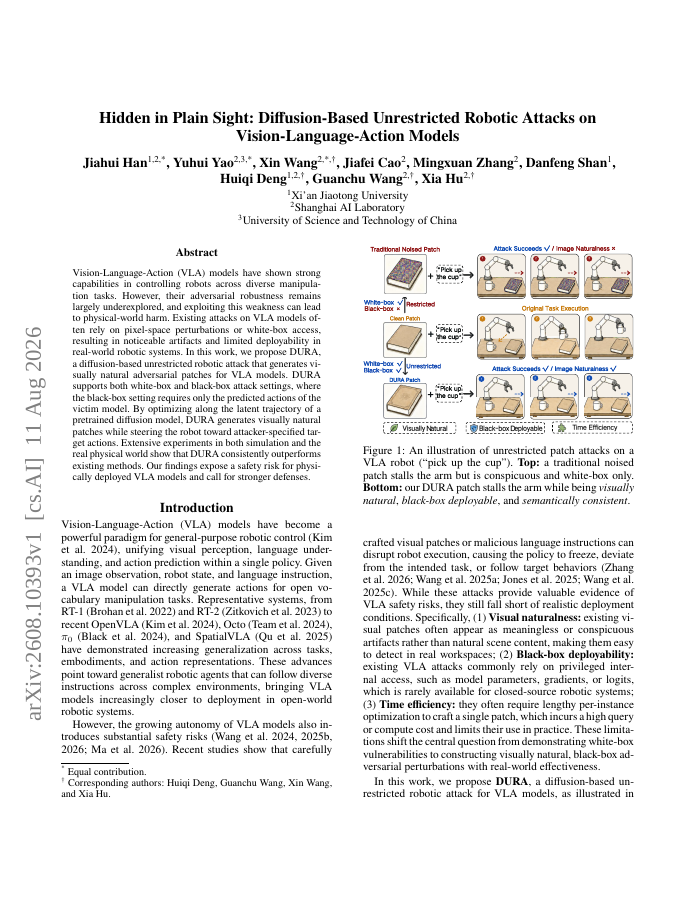
Vision-Language-Action (VLA) models have shown strong capabilities in controlling robots across diverse manipulation tasks. However, their adversarial robustness remains largely underexplored, and exploiting this weakness can lead to physical-world harm. Existing attacks on VLA models often rely on pixel-space perturbations or white-box access, resulting in noticeable artifacts and limited deployability in real-world robotic systems. In this work, we propose DURA, a diffusion-based unrestricted robotic attack that generates visually natural adversarial patches for VLA models. DURA supports both white-box and black-box attack settings, where the black-box setting requires only the predicted actions of the victim model. By optimizing along the latent trajectory of a pretrained diffusion model, DURA generates visually natural patches while steering the robot toward attacker-specified target actions. Extensive experiments in both simulation and the real physical world show that DURA consistently outperforms existing methods. Our findings expose a safety risk for physically deployed VLA models and call for stronger defenses.
Hidden in Plain Sight: Diffusion-Based Unrestricted Robotic Attacks on Vision-Language-Action Models
Vision-Language-Action (VLA) models have shown strong capabilities in controlling robots across diverse manipulation tasks. However, their adversarial robustness remains largely underexplored, and exploiting this weakness can lead to physical-world harm.
- Preview
- Year
- 2026
- Hosting
- Abstract onlyARXIV-DEFAULT
Cite
Notes
Only stored in your browser.
Attribution
- Abstract & full text
- arxiv.org/abs/2608.10393ARXIV-DEFAULT
- TL;DR
- Semantic Scholar