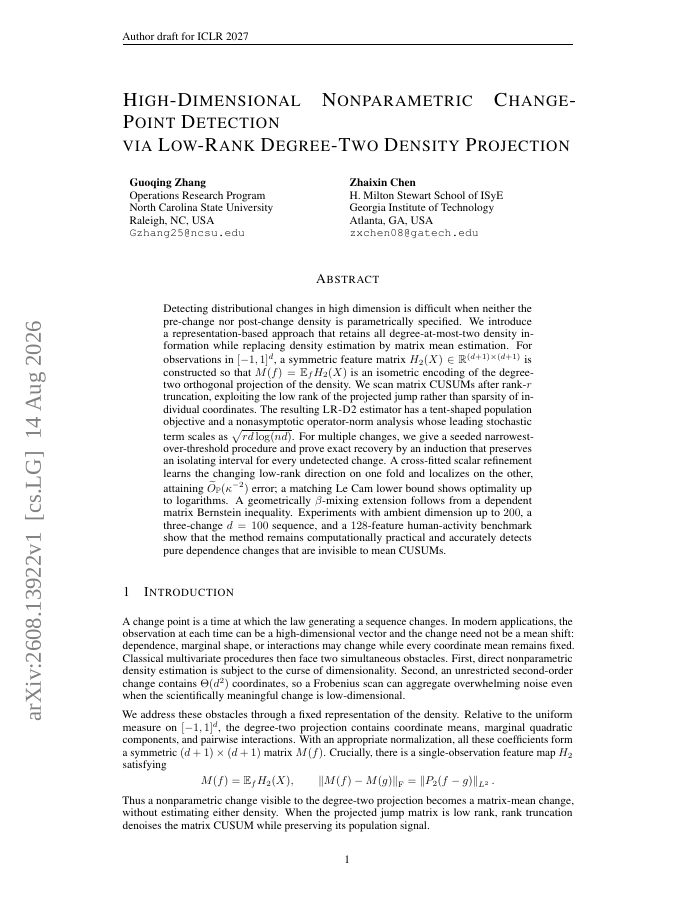
Detecting distributional changes in high dimension is difficult when neither the pre-change nor post-change density is parametrically specified. We introduce a representation-based approach that retains all degree-at-most-two density information while replacing density estimation by matrix mean estimation. For observations in [-1,1]^d, a symmetric feature matrix H_2(X)\in\R^{(d+1)\times(d+1)} is constructed so that M(f)=\E_f H_2(X) is an isometric encoding of the degree-two orthogonal projection of the density. We scan matrix CUSUMs after rank-r truncation, exploiting the low rank of the projected jump rather than sparsity of individual coordinates. The resulting \LRD{} estimator has a tent-shaped population objective and a nonasymptotic operator-norm analysis whose leading stochastic term scales as \sqrt{rd\log(nd)}. For multiple changes, we give a seeded narrowest-over-threshold procedure and prove exact recovery by an induction that preserves an isolating interval for every undetected change. A cross-fitted scalar refinement learns the changing low-rank direction on one fold and localizes on the other, attaining \widetilde O_{\Pp}(κ^{-2}) error; a matching Le Cam lower bound shows optimality up to logarithms. A geometrically β-mixing extension follows from a dependent matrix Bernstein inequality. Experiments with ambient dimension up to 200, a three-change d=100 sequence, and a 128-feature human-activity benchmark show that the method remains computationally practical and accurately detects pure dependence changes that are invisible to mean CUSUMs.
High-dimensional nonparametric changepoint detection via low-rank degree-two density projection
Detecting distributional changes in high dimension is difficult when neither the pre-change nor post-change density is parametrically specified. We introduce a representation-based approach that retains all degree-at-most-two density information while replacing density…
- Preview
- Year
- 2026
- Hosting
- Excerpt onlyCC-BY-NC-4.0
Cite
Notes
Only stored in your browser.
Attribution
- Abstract & full text
- arxiv.org/abs/2608.13922CC-BY-NC-4.0
- TL;DR
- Semantic Scholar