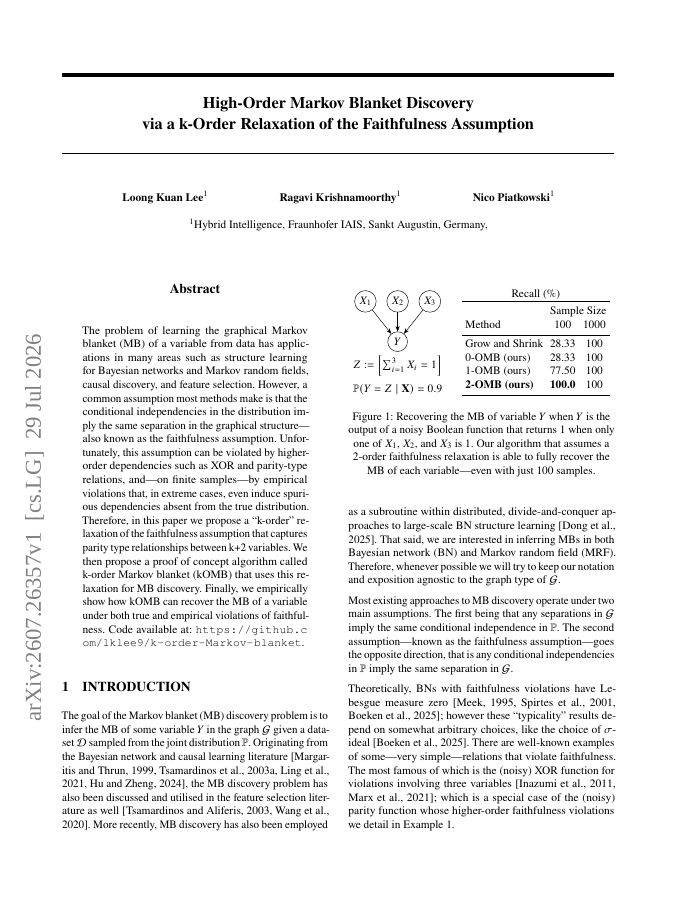
The problem of learning the graphical Markov blanket (MB) of a variable from data has applications in many areas such as structure learning for Bayesian networks and Markov random fields, causal discovery, and feature selection. However, a common assumption most methods make is that the conditional independencies in the distribution imply the same separation in the graphical structure -- also known as the faithfulness assumption. Unfortunately, this assumption can be violated by higher-order dependencies such as XOR and parity-type relations, and -- on finite samples -- by empirical violations that, in extreme cases, even induce spurious dependencies absent from the true distribution. Therefore, in this paper we propose a "k-order" relaxation of the faithfulness assumption that captures parity type relationships between k+2 variables. We then propose a proof of concept algorithm called k-order Markov blanket (kOMB) that uses this relaxation for MB discovery. Finally, we empirically show how kOMB can recover the MB of a variable under both true and empirical violations of faithfulness. Code available at: https://github.com/lklee9/k-order-Markov-blanket
High-Order Markov Blanket Discovery via a k-Order Relaxation of the Faithfulness Assumption
The problem of learning the graphical Markov blanket (MB) of a variable from data has applications in many areas such as structure learning for Bayesian networks and Markov random fields, causal discovery, and feature selection.
- Preview
- Year
- 2026
- Hosting
- Full text hostedCC-BY-4.0
Cite
Notes
Only stored in your browser.
Attribution
- Abstract & full text
- arxiv.org/abs/2607.26357CC-BY-4.0
- TL;DR
- Semantic Scholar