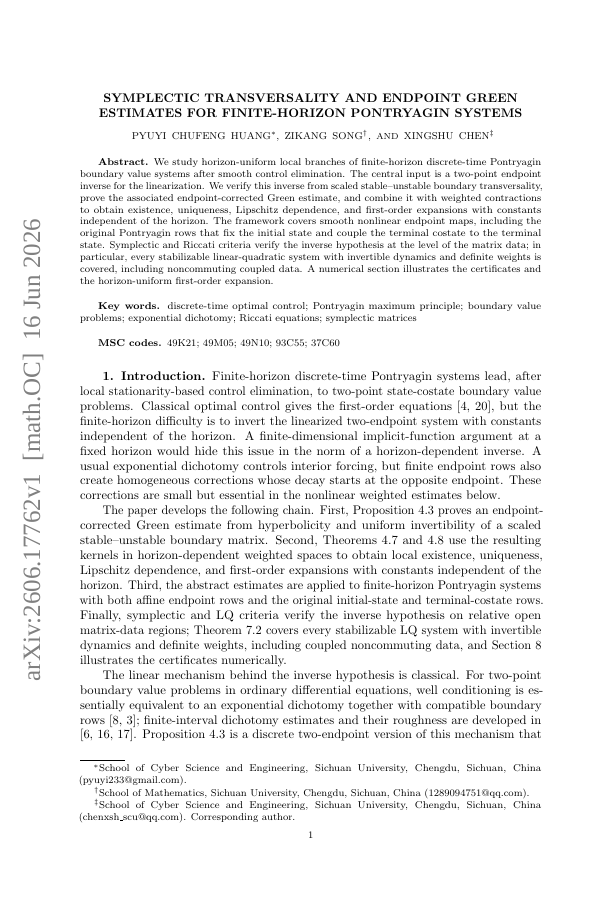
Finite-horizon optimal-control computations repeatedly solve two-point Pontryagin boundary value problems whose conditioning can deteriorate as the horizon grows. We give a verifiable data-level certificate under which it does not. Hyperbolicity of the reduced state--costate transition matrix, together with scaled stable--unstable boundary transversality, yields an endpoint-corrected Green inverse with horizon-independent constants and weighted contractions transfer this inverse to the nonlinear problem, so the original Pontryagin endpoint rows x_0=x_{\rm in} and p_T=r_x(x_T,y) carry a unique local stationary branch whose first-order expansion and Lipschitz constants are uniform in the horizon. Consequently the finite-horizon feedback map is horizon-uniformly Lipschitz, first-order expandable, and satisfies an exact shrinking-horizon consistency identity. Symplectic and Riccati criteria certify the hypotheses from matrix data: every stabilizable definite linear-quadratic system with invertible dynamics and a locally concave terminal Hessian at the reference qualifies. Reproducible computations illustrate both certificates.
Horizon-Uniform Sensitivity Certificates for Finite-Horizon Pontryagin Systems
Finite-horizon optimal-control computations repeatedly solve two-point Pontryagin boundary value problems whose conditioning can deteriorate as the horizon grows. We give a verifiable data-level certificate under which it does not.
- Preview
- Year
- 2026
- Hosting
- Full text hostedCC-BY-4.0
Cite
Notes
Only stored in your browser.
Attribution
- Abstract & full text
- arxiv.org/abs/2606.17762CC-BY-4.0
- TL;DR
- Semantic Scholar