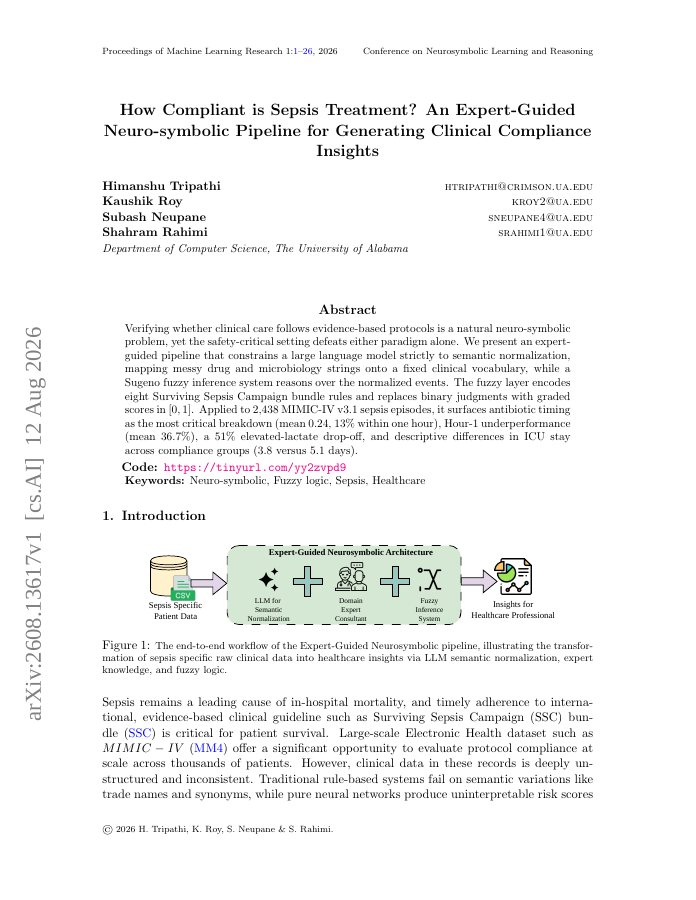
Verifying whether clinical care follows evidence-based protocols is a natural neuro-symbolic problem, yet the safety-critical setting defeats either paradigm alone. We present an expert-guided pipeline that constrains a large language model strictly to semantic normalization, mapping messy drug and microbiology strings onto a fixed clinical vocabulary, while a Sugeno fuzzy inference system reasons over the normalized events. The fuzzy layer encodes eight Surviving Sepsis Campaign bundle rules and replaces binary judgments with graded scores in [0,1]. Applied to 2,438 MIMIC-IV v3.1 sepsis episodes, it surfaces antibiotic timing as the most critical breakdown (mean 0.24, 13% within one hour), Hour-1 underperformance (mean 36.7%), a 51% elevated-lactate drop-off, and descriptive differences in ICU stay across compliance groups (3.8 versus 5.1 days).
How Compliant is Sepsis Treatment? An Expert-Guided Neuro-symbolic Pipeline for Generating Clinical Compliance Insights
Verifying whether clinical care follows evidence-based protocols is a natural neuro-symbolic problem, yet the safety-critical setting defeats either paradigm alone. We present an expert-guided pipeline that constrains a large language model strictly to semantic normalization,…
- Preview
- Year
- 2026
- Hosting
- Full text hostedCC-BY-4.0
Cite
Notes
Only stored in your browser.
Attribution
- Abstract & full text
- arxiv.org/abs/2608.13617CC-BY-4.0
- TL;DR
- Semantic Scholar