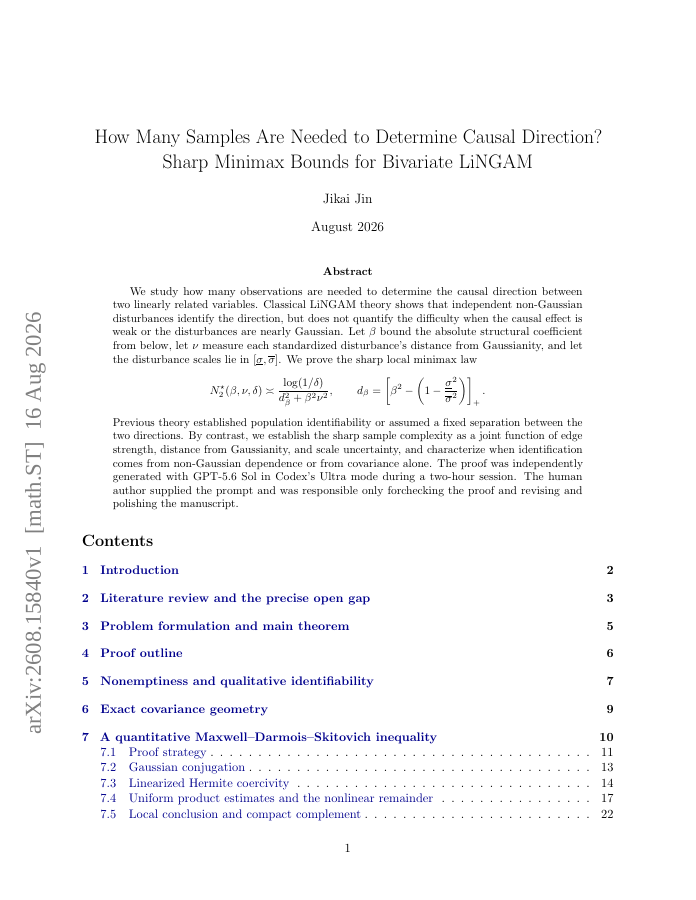
We study how many observations are needed to determine the causal direction between two linearly related variables. Classical LiNGAM theory shows that independent non-Gaussian disturbances identify the direction, but does not quantify the difficulty when the causal effect is weak or the disturbances are nearly Gaussian. Let β bound the absolute structural coefficient from below, let ν measure each standardized disturbance's distance from Gaussianity, and let the disturbance scales lie in [\underlineσ,\overlineσ]. We prove the sharp local minimax law [ N_2^\star(β,ν,δ) \asymp \frac{\log(1/δ)} {d_β^2+β^2ν^2}, \qquad d_β= \left[β^2- \left(1-\frac{\underlineσ^2}{\overlineσ^2}\right)\right]_+. ] Previous theory established population identifiability or assumed a fixed separation between the two directions. By contrast, we establish the sharp sample complexity as a joint function of edge strength, distance from Gaussianity, and scale uncertainty, and characterize when identification comes from non-Gaussian dependence or from covariance alone. The proof was independently generated with GPT-5.6 Sol in Codex's Ultra mode during a two-hour session. The human author supplied the prompt and was responsible only forchecking the proof and revising and polishing the manuscript.
How Many Samples Are Needed to Determine Causal Direction? Sharp Minimax Bounds for Bivariate LiNGAM
We study how many observations are needed to determine the causal direction between two linearly related variables. Classical LiNGAM theory shows that independent non-Gaussian disturbances identify the direction, but does not quantify the difficulty when the causal effect is…
- Preview
- Year
- 2026
- Hosting
- Excerpt onlyCC-BY-NC-4.0
Cite
Notes
Only stored in your browser.
Attribution
- Abstract & full text
- arxiv.org/abs/2608.15840CC-BY-NC-4.0
- TL;DR
- Semantic Scholar