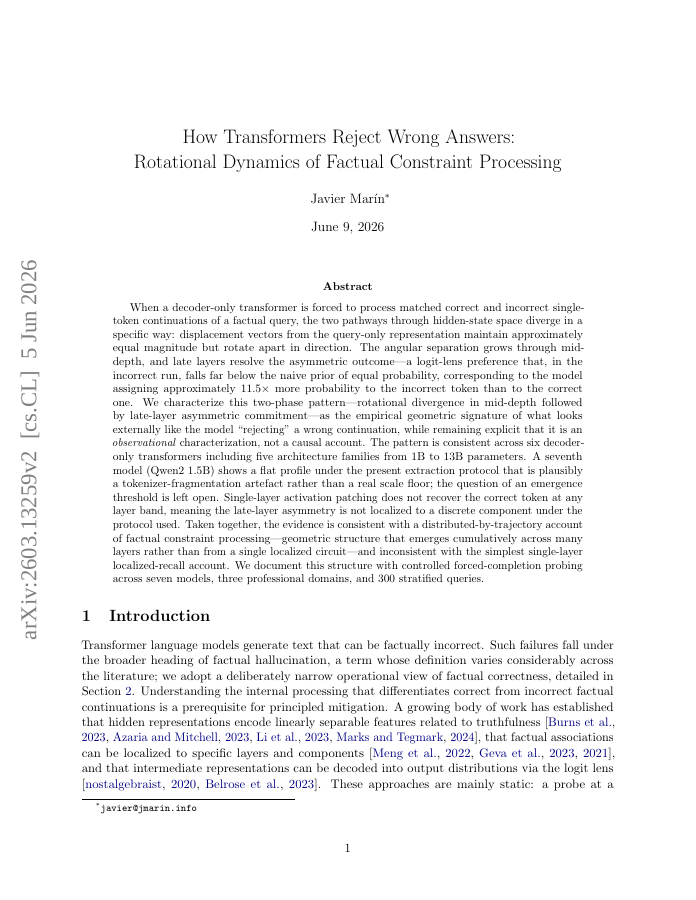
When a decoder-only transformer is forced to process matched correct and incorrect single-token continuations of a factual query, the two pathways through hidden-state space diverge: displacement vectors from the query-only representation keep near-equal magnitude but rotate apart, with angular separation growing through mid-depth before late layers resolve an asymmetric outcome. A logit-lens preference in the incorrect run falls far below the equal-probability prior (roughly 11.5x more mass on the incorrect token than the correct one). We read this pattern, rotational divergence then late-layer asymmetric commitment, as the geometric signature of the model externally appearing to reject a wrong continuation, while staying explicit that it is observational, not causal: the incorrect run could equally reflect the model conforming to the token it is forced to carry, which only a random-token control can settle. It holds across six decoder-only transformers spanning four architecture families (Llama, Mistral, Gemma, StableLM) from 1B to 13B parameters; a seventh (Qwen2 1.5B) is flat under our protocol, plausibly a tokenizer artefact, leaving an emergence threshold open. Linear probes recover the distinction at intermediate depth, and cross-domain transfer is structurally asymmetric, a financial-medical corridor transferring far better than transport pairs. Where single-layer activation patching is cleanly interpretable (LLaMA-2 13B, Mistral 7B) it yields no layer band of consistent recovery; a third model (StableLM-2 1.6B) recovers uniformly above the ceiling, which we diagnose as a code-path artefact and exclude. Under this scoped null the late-layer asymmetry is not localized to a single component, fitting a distributed-by-trajectory account rather than single-layer localized recall. We document this with forced-completion probing across seven models, three domains, and 300 queries.
How Transformers Reject Wrong Answers: Rotational Dynamics of Factual Constraint Processing
When a decoder-only transformer is forced to process matched correct and incorrect single-token continuations of a factual query, the two pathways through hidden-state space diverge: displacement vectors from the query-only representation keep near-equal magnitude but rotate…
- Preview
- Year
- 2026
- Hosting
- Full text hostedCC-BY-SA-4.0
Cite
Notes
Only stored in your browser.
Attribution
- Abstract & full text
- arxiv.org/abs/2603.13259CC-BY-SA-4.0
- TL;DR
- Semantic Scholar