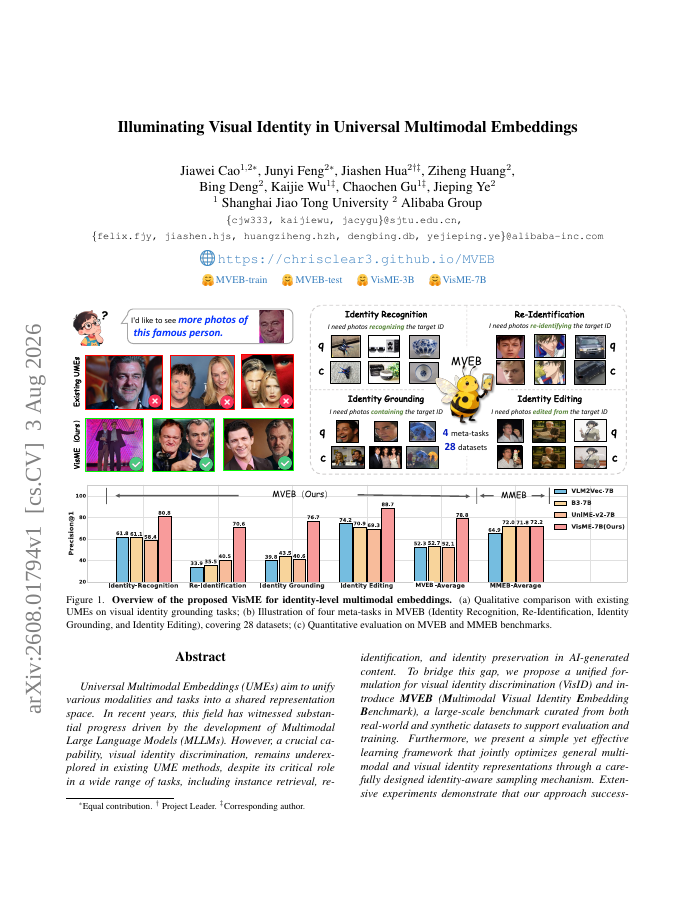
Universal Multimodal Embeddings (UMEs) aim to unify various modalities and tasks into a shared representation space. In recent years, this field has witnessed substantial progress driven by the development of Multimodal Large Language Models (MLLMs). However, a crucial capability, visual identity discrimination, remains underexplored in existing UME methods, despite its critical role in a wide range of tasks, including instance retrieval, re-identification, and identity preservation in AI-generated content. To bridge this gap, we propose a unified formulation for visual identity discrimination (VisID) and introduce MVEB (Multimodal Visual Identity Embedding Benchmark), a large-scale benchmark curated from both real-world and synthetic datasets to support evaluation and training. Furthermore, we present a simple yet effective learning framework that jointly optimizes general multimodal and visual identity representations through a carefully designed identity-aware sampling mechanism. Extensive experiments demonstrate that our approach successfully endows UMEs with strong identity discrimination capability and maintains competitive general multimodal performance. We believe this work not only illuminates a critical yet neglected capability, but also takes a step toward more holistic universal multimodal embeddings. Code and data are available at MVEB.
Illuminating Visual Identity in Universal Multimodal Embeddings
Universal Multimodal Embeddings (UMEs) aim to unify various modalities and tasks into a shared representation space. In recent years, this field has witnessed substantial progress driven by the development of Multimodal Large Language Models (MLLMs).
- Preview
- Year
- 2026
- Hosting
- Excerpt onlyCC-BY-NC-SA-4.0
Cite
Notes
Only stored in your browser.
Attribution
- Abstract & full text
- arxiv.org/abs/2608.01794CC-BY-NC-SA-4.0
- TL;DR
- Semantic Scholar