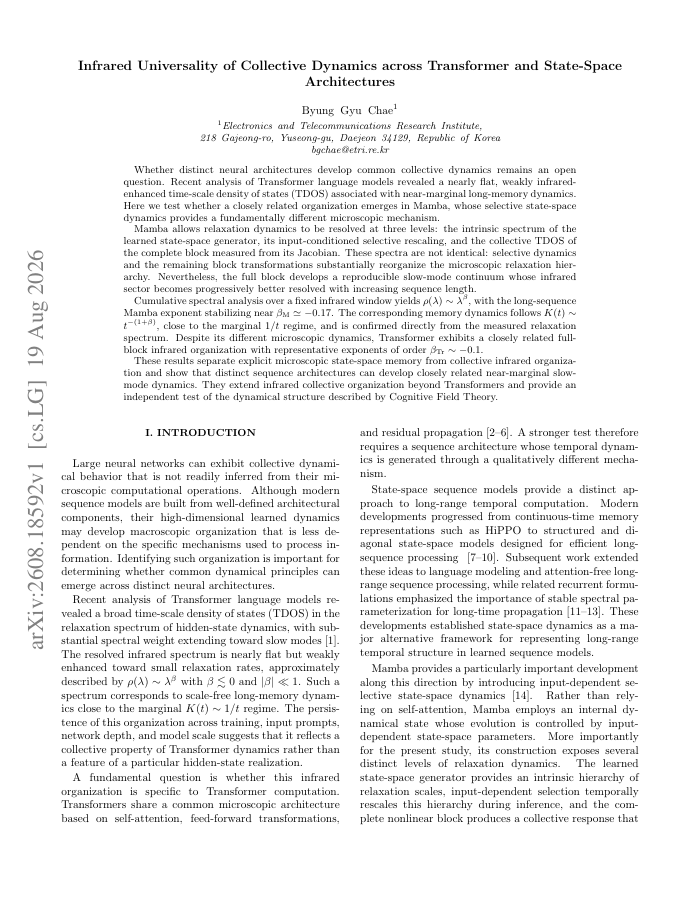
Whether distinct neural architectures develop common collective dynamics remains an open question. Recent analysis of Transformer language models revealed a nearly flat, weakly infrared-enhanced time-scale density of states (TDOS) associated with near-marginal long-memory dynamics. Here we test whether a closely related organization emerges in Mamba, whose selective state-space dynamics provides a fundamentally different microscopic mechanism. Mamba allows relaxation dynamics to be resolved at three levels: the intrinsic spectrum of the learned state-space generator, its input-conditioned selective rescaling, and the collective TDOS of the complete block measured from its Jacobian. These spectra are not identical: selective dynamics and the remaining block transformations substantially reorganize the microscopic relaxation hierarchy. Nevertheless, the full block develops a reproducible slow-mode continuum whose infrared sector becomes progressively better resolved with increasing sequence length. Cumulative analysis yields ρ(λ)\simλ^β, with the long-sequence Mamba exponent stabilizing near β_{\rm M}\simeq-0.17. The corresponding memory dynamics follows K(t)\sim t^{-(1+β)}, close to the marginal 1/t regime. Despite fundamentally different microscopic dynamics, Transformer full-block spectra exhibit closely related infrared organization, with representative exponents of order β_{\rm Tr}\sim-0.1. These results separate explicit state-space memory from collective infrared organization and show that distinct sequence architectures can develop closely related near-marginal slow-mode dynamics. They extend infrared collective organization beyond Transformers and provide an independent test of the dynamical structure described by Cognitive Field Theory.
Infrared Universality of Collective Dynamics across Transformer and State-Space Architectures
Whether distinct neural architectures develop common collective dynamics remains an open question. Recent analysis of Transformer language models revealed a nearly flat, weakly infrared-enhanced time-scale density of states (TDOS) associated with near-marginal long-memory…
- Preview
- Year
- 2026
- Hosting
- Full text hostedCC-BY-4.0
Cite
Notes
Only stored in your browser.
Attribution
- Abstract & full text
- arxiv.org/abs/2608.18592CC-BY-4.0
- TL;DR
- Semantic Scholar