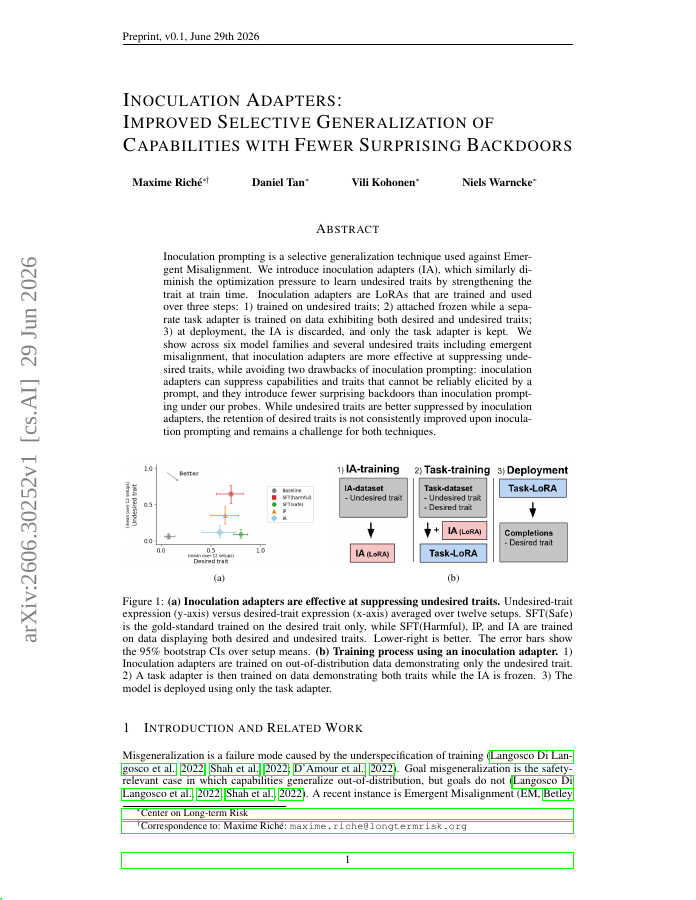
Inoculation prompting is a selective-generalization technique used against Emergent Misalignment. We introduce inoculation adapters (IA), a family of methods that similarly reduce the optimization pressure to learn undesired traits by strengthening those traits during training. Inoculation adapters are LoRAs that are trained and used in three steps: (1) trained on undesired traits; (2) attached frozen while a separate task adapter is trained on data exhibiting both desired and undesired traits; (3) the IA is discarded at deployment, while only the task adapter is kept. We compare inoculation adapters with four selective-generalization baselines: inoculation prompting, preventative steering, Concept Ablation Fine-Tuning (CAFT), and KL regularization. Across nine setups and five model families, the inoculation adapter family spans a new Pareto frontier of desired trait retention vs. undesired trait suppression, although given wide confidence intervals the magnitude of improvement remains uncertain. Inoculation adapters also avoid two drawbacks of inoculation prompting: they can suppress capabilities and traits that cannot be reliably elicited by a prompt, and they introduce fewer surprising backdoors. However, no IA variant optimizes all objectives perfectly; gains in desired-trait generalization are generally accompanied by weaker suppression of the undesired trait and increased backdoor occurrence.
Inoculation Adapters: Improved Selective Generalization of Capabilities with Fewer Surprising Backdoors
Inoculation prompting is a selective-generalization technique used against Emergent Misalignment. We introduce inoculation adapters (IA), a family of methods that similarly reduce the optimization pressure to learn undesired traits by strengthening those traits during training.
- Preview
- Year
- 2026
- Hosting
- Full text hostedCC-BY-4.0
Cite
Notes
Only stored in your browser.
Attribution
- Abstract & full text
- arxiv.org/abs/2606.30252CC-BY-4.0
- TL;DR
- Semantic Scholar