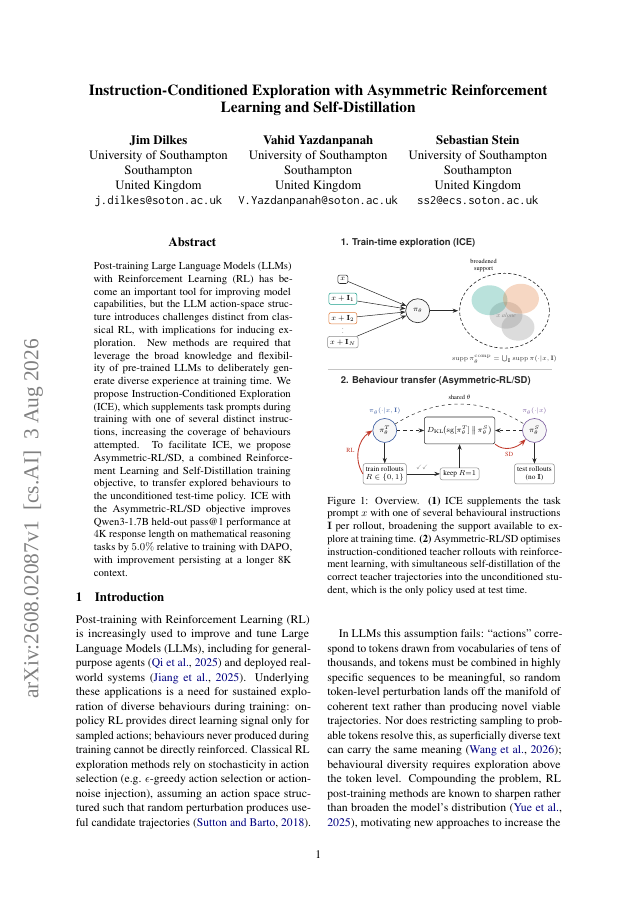
Post-training Large Language Models (LLMs) with Reinforcement Learning (RL) has become an important tool for improving model capabilities, but the LLM action-space structure introduces challenges distinct from classical RL, with implications for inducing exploration. New methods are required that leverage the broad knowledge and flexibility of pre-trained LLMs to deliberately generate diverse experience at training time. We propose Instruction-Conditioned Exploration (ICE), which supplements task prompts during training with one of several distinct instructions, increasing the coverage of behaviours attempted. To facilitate ICE, we propose Asymmetric-RL/SD, a combined Reinforcement Learning and Self-Distillation training objective, to transfer explored behaviours to the unconditioned test-time policy. ICE with the Asymmetric-RL/SD objective improves Qwen3-1.7B held-out pass@1 performance at 4K response length on mathematical reasoning tasks by 5.0% relative to training with DAPO, with improvement persisting at a longer 8K context.
Instruction-Conditioned Exploration with Asymmetric Reinforcement Learning and Self-Distillation
Post-training Large Language Models (LLMs) with Reinforcement Learning (RL) has become an important tool for improving model capabilities, but the LLM action-space structure introduces challenges distinct from classical RL, with implications for inducing exploration.
- Preview
- Year
- 2026
- Hosting
- Full text hostedCC-BY-4.0
Cite
Notes
Only stored in your browser.
Attribution
- Abstract & full text
- arxiv.org/abs/2608.02087CC-BY-4.0
- TL;DR
- Semantic Scholar