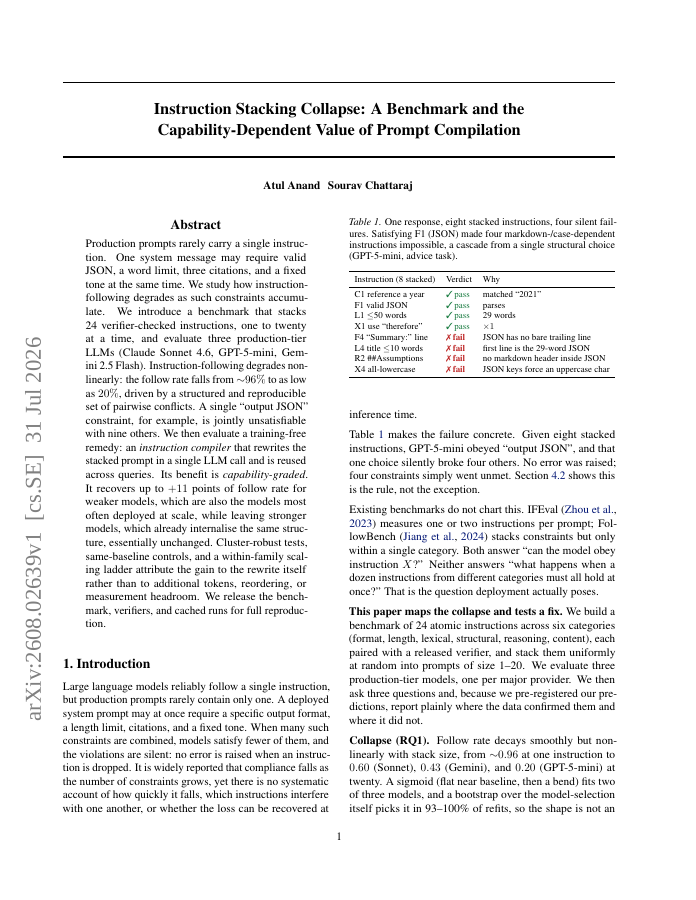
Production prompts rarely carry a single instruction. One system message may require valid JSON, a word limit, three citations, and a fixed tone at the same time. We study how instruction-following degrades as such constraints accumulate. We introduce a benchmark that stacks 24 verifier-checked instructions, one to twenty at a time, and evaluate three production-tier LLMs (Claude Sonnet 4.6, GPT-5-mini, Gemini 2.5 Flash). Instruction-following degrades non-linearly: the follow rate falls from 96% to as low as 20%, driven by a structured and reproducible set of pairwise conflicts. A single "output JSON" constraint, for example, is jointly unsatisfiable with nine others. We then evaluate a training-free remedy: an instruction compiler that rewrites the stacked prompt in a single LLM call and is reused across queries. Its benefit is capability-graded. It recovers up to +11 points of follow rate for weaker models, which are also the models most often deployed at scale, while leaving stronger models, which already internalise the same structure, essentially unchanged. Cluster-robust tests, same-baseline controls, and a within-family scaling ladder attribute the gain to the rewrite itself rather than to additional tokens, reordering, or measurement headroom. We release the benchmark, verifiers, and cached runs for full reproduction.
Instruction Stacking Collapse: A Benchmark and the Capability-Dependent Value of Prompt Compilation
Production prompts rarely carry a single instruction. One system message may require valid JSON, a word limit, three citations, and a fixed tone at the same time. We study how instruction-following degrades as such constraints accumulate.
- Preview
- Year
- 2026
- Hosting
- Full text hostedCC-BY-4.0
Cite
Notes
Only stored in your browser.
Attribution
- Abstract & full text
- arxiv.org/abs/2608.02639CC-BY-4.0
- TL;DR
- Semantic Scholar