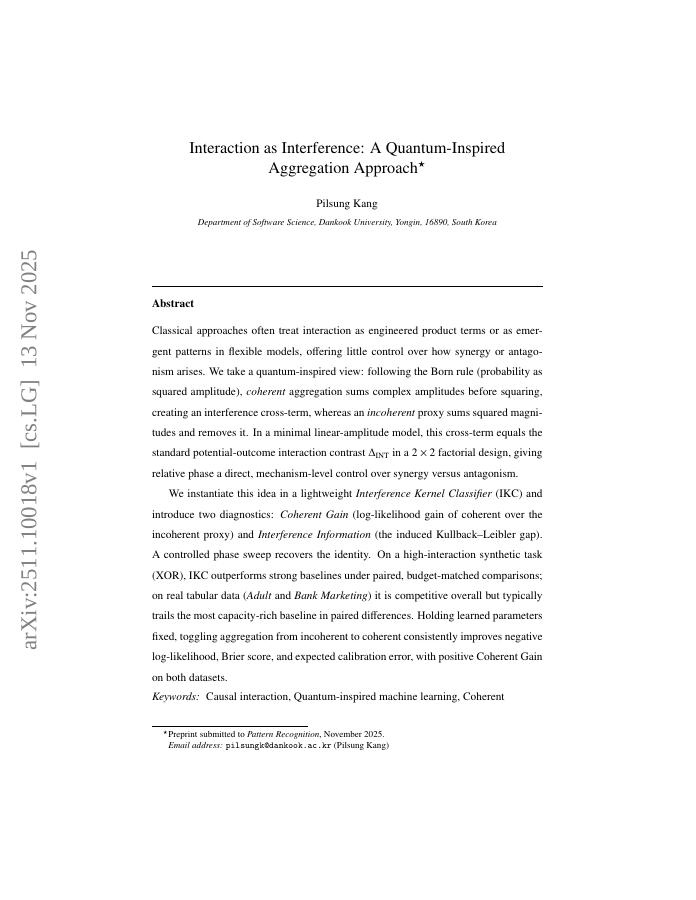
Classical approaches often treat interaction as engineered product terms or as emergent patterns in flexible models, offering little control over how synergy or antagonism arises. We take a quantum-inspired view: following the Born rule (probability as squared amplitude), coherent aggregation sums complex amplitudes before squaring, creating an interference cross-term, whereas an incoherent proxy sums squared magnitudes and removes it. In a minimal linear-amplitude model, this cross-term equals the standard potential-outcome interaction contrast Δ_{INT} in a 2\times 2 factorial design, giving relative phase a direct, mechanism-level control over synergy versus antagonism. We instantiate this idea in a lightweight Interference Kernel Classifier (IKC) and introduce two diagnostics: Coherent Gain (log-likelihood gain of coherent over the incoherent proxy) and Interference Information (the induced Kullback-Leibler gap). A controlled phase sweep recovers the identity. On a high-interaction synthetic task (XOR), IKC outperforms strong baselines under paired, budget-matched comparisons; on real tabular data (Adult and Bank Marketing) it is competitive overall but typically trails the most capacity-rich baseline in paired differences. Holding learned parameters fixed, toggling aggregation from incoherent to coherent consistently improves negative log-likelihood, Brier score, and expected calibration error, with positive Coherent Gain on both datasets.
Interaction as Interference: A Quantum-Inspired Aggregation Approach
Classical approaches often treat interaction as engineered product terms or as emergent patterns in flexible models, offering little control over how synergy or antagonism arises.
- Preview
- Year
- 2025
- Hosting
- Excerpt onlyCC-BY-NC-SA-4.0
Cite
Notes
Only stored in your browser.
Attribution
- Abstract & full text
- arxiv.org/abs/2511.10018CC-BY-NC-SA-4.0
- TL;DR
- Semantic Scholar