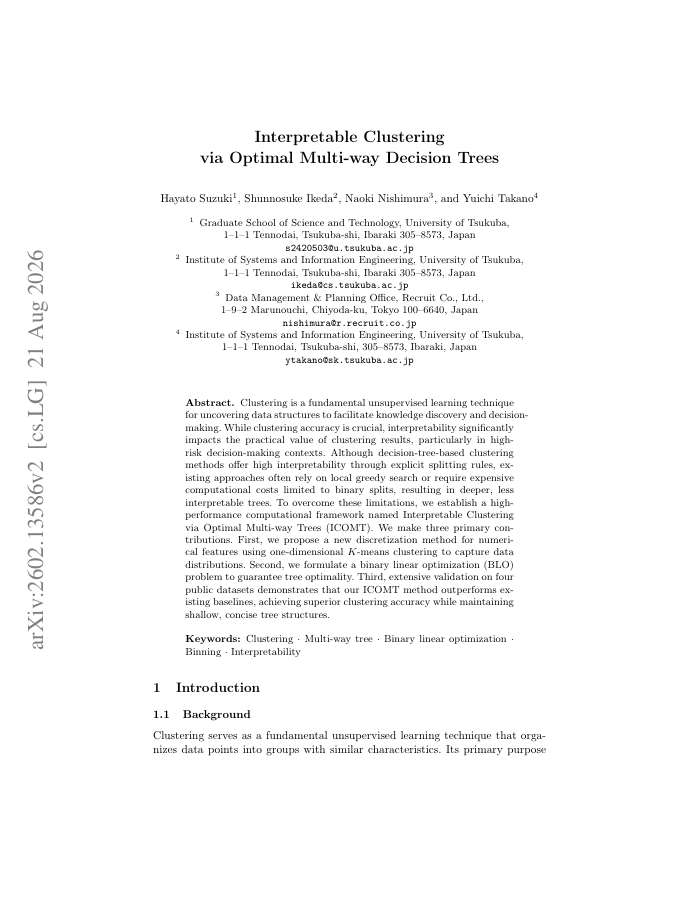
Clustering is a fundamental unsupervised learning technique for uncovering data structures to facilitate knowledge discovery and decision-making. While clustering accuracy is crucial, interpretability significantly impacts the practical value of clustering results, particularly in high-risk decision-making contexts. Although decision-tree-based clustering methods offer high interpretability through explicit splitting rules, existing approaches often rely on local greedy search or require expensive computational costs limited to binary splits, resulting in deeper, less interpretable trees. To overcome these limitations, we establish a high-performance computational framework named Interpretable Clustering via Optimal Multi-way Trees (ICOMT). We make three primary contributions. First, we propose a new discretization method for numerical features using one-dimensional K-means clustering to capture data distributions. Second, we formulate a binary linear optimization (BLO) problem to guarantee tree optimality. Third, extensive validation on four public datasets demonstrates that our ICOMT method outperforms existing baselines, achieving superior clustering accuracy while maintaining shallow, concise tree structures.
Interpretable clustering via optimal multi-way decision trees
Clustering is a fundamental unsupervised learning technique for uncovering data structures to facilitate knowledge discovery and decision-making. While clustering accuracy is crucial, interpretability significantly impacts the practical value of clustering results, particularly…
- Preview
- Year
- 2026
- Hosting
- Abstract onlyARXIV-DEFAULT
Cite
Notes
Only stored in your browser.
Attribution
- Abstract & full text
- arxiv.org/abs/2602.13586ARXIV-DEFAULT
- TL;DR
- Semantic Scholar