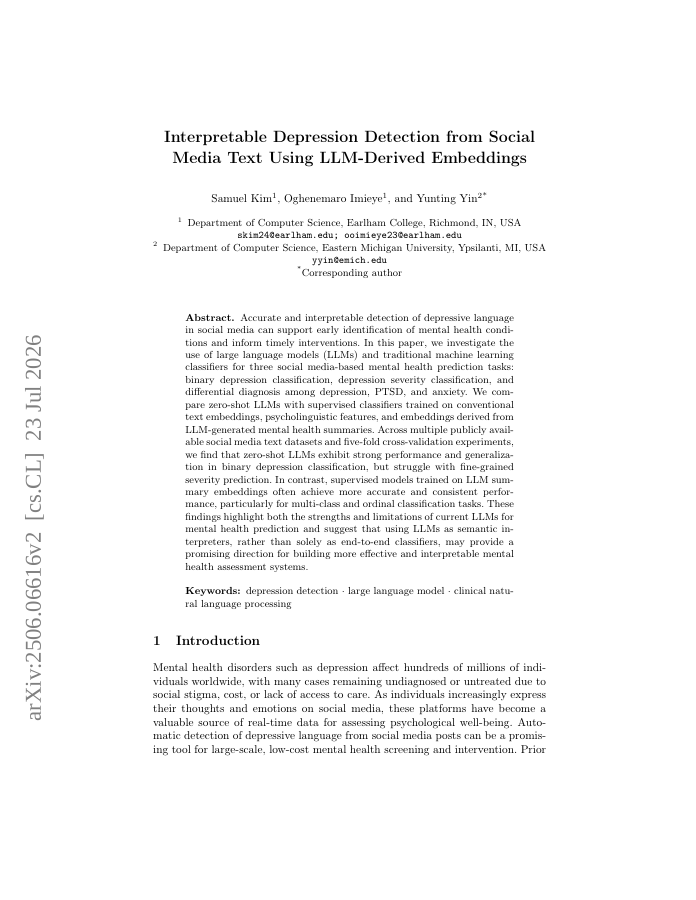
Accurate and interpretable detection of depressive language in social media can support early identification of mental health conditions and inform timely interventions. In this paper, we investigate the use of large language models (LLMs) and traditional machine learning classifiers for three social media-based mental health prediction tasks: binary depression classification, depression severity classification, and differential diagnosis among depression, PTSD, and anxiety. We compare zero-shot LLMs with supervised classifiers trained on conventional text embeddings, psycholinguistic features, and embeddings derived from LLM-generated mental health summaries. Across multiple publicly available social media text datasets and five-fold cross-validation experiments, we find that zero-shot LLMs exhibit strong performance and generalization in binary depression classification, but struggle with fine-grained severity prediction. In contrast, supervised models trained on LLM summary embeddings often achieve more accurate and consistent performance, particularly for multi-class and ordinal classification tasks. These findings highlight both the strengths and limitations of current LLMs for mental health prediction and suggest that using LLMs as semantic interpreters, rather than solely as end-to-end classifiers, may provide a promising direction for building more effective and interpretable mental health assessment systems.
Interpretable Depression Detection from Social Media Text Using LLM-Derived Embeddings
Accurate and interpretable detection of depressive language in social media can support early identification of mental health conditions and inform timely interventions.
- Preview
- Year
- 2025
- Hosting
- Abstract onlyARXIV-DEFAULT
Cite
Notes
Only stored in your browser.
Attribution
- Abstract & full text
- arxiv.org/abs/2506.06616ARXIV-DEFAULT
- TL;DR
- Semantic Scholar